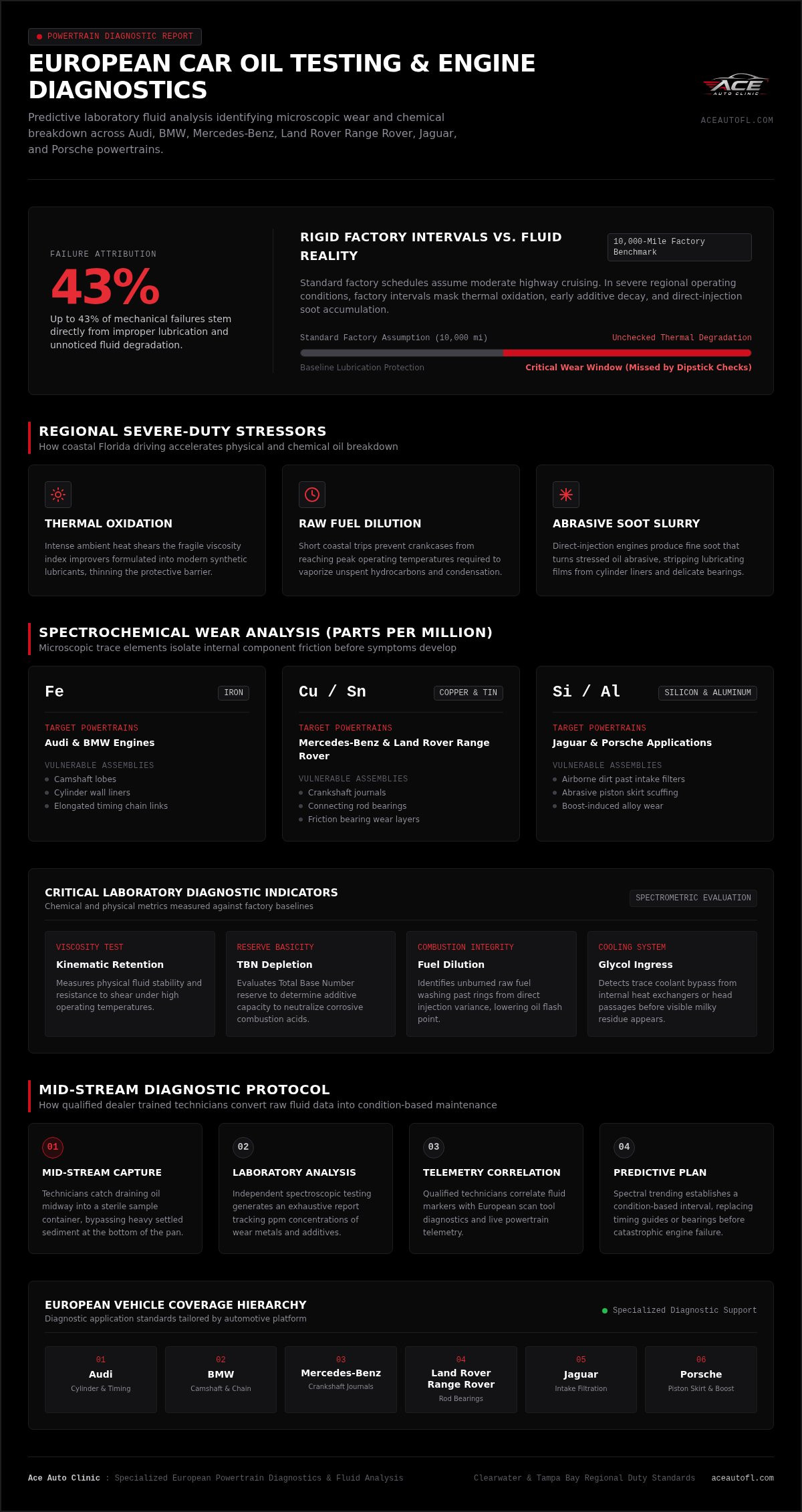
Improper lubrication contributes to up to 43% of mechanical failures, yet conventional service schedules often treat engine lubricant as an afterthought. When you drive an Audi, BMW, or Mercedes-Benz, relying strictly on standard factory intervals under Florida's intense heat and stop-and-go traffic can accelerate component wear. Specialized European car oil testing provides the predictive diagnostic clarity required to protect these high-performance engines before severe damage occurs.
You shouldn't have to guess whether fuel dilution or elevated wear metals are compromising your powertrain. In this guide, you will discover how laboratory fluid analysis identifies microscopic degradation across bearings, timing chains, and turbochargers. We will examine what spectrographic reports reveal and how specialized diagnostic data establishes a dependable, condition-based maintenance schedule for your vehicle.
Key Takeaways
- Learn how spectrochemical analysis pinpoints microscopic traces of iron, copper, and aluminum to identify component wear before mechanical symptoms appear.
- Discover how European car oil testing uncovers critical contamination like raw fuel dilution, coolant leaks, and soot accumulation that undermine lubrication.
- Understand why severe Florida heat and stop-and-go driving accelerate thermal oxidation, demanding more precise fluid evaluations than standard factory schedules provide.
- Find out how sterile mid-stream sampling and trending spectral reports help qualified technicians build a customized, condition-based maintenance schedule.
What European Car Oil Testing Reveals About Internal Engine Health
Standard oil changes don't uncover the gradual chemical and mechanical breakdown taking place inside high-performance powertrains. Through laboratory oil analysis, qualified technicians evaluate the operational health of lubricants under thermal stress. Professional oil and fluid testing measures critical physical properties, including kinematic viscosity retention and Total Base Number (TBN) depletion against strict factory baselines. This diagnostic approach identifies damaging chemical contamination early, detecting raw fuel dilution from direct injectors, glycol ingress from cooling passages, and abrasive soot suspension.
Critical Wear Metals and What They Mean for Luxury Engines
Spectrochemical analysis isolates microscopic wear debris suspended in the oil matrix, measuring elements down to parts per million. European car oil testing categorizes these suspended trace metals to diagnose wear across specific assemblies before catastrophic mechanical failure develops:
- Iron: Elevated iron values indicate abnormal friction on camshaft lobes, cylinder wall liners, or elongated timing chain links in complex Audi and BMW engines.
- Copper and Tin: The presence of these softer metals signals accelerated friction bearing wear across crankshaft journals and connecting rod bearings within Mercedes-Benz and Land Rover Range Rover powertrains.
- Silicon and Aluminum: High silicon levels reflect airborne dirt bypassing intake filters, which mixes with oil to cause abrasive piston skirt scuffing under boost in Jaguar and Porsche applications.
Tracking these elemental shifts across subsequent drains creates an objective diagnostic record, protecting precision machinery from irreversible internal damage.
Why Florida Driving Conditions Demand Frequent European Fluid Diagnostics
Florida's coastal heat and humidity subject high-output engines to harsh operating environments. High ambient temperatures accelerate thermal oxidation, shearing the fragile viscosity index improvers engineered into modern synthetic oils. In stop-and-go coastal traffic across Clearwater and Tampa Bay, short trips prevent crankcases from reaching temperatures needed to burn off unspent hydrocarbons and condensation. This pattern fosters crankcase fuel dilution, accelerating carbon buildup and stripping the protective oil film from cylinder liners. Without laboratory diagnostics, this gradual thinning remains undetectable until mechanical friction causes noticeable damage. Regular European car oil testing provides empirical insight into physical fluid stability, confirming whether lubricants still protect tight tolerances.
The Problem with Rigid Factory Service Intervals
Standard 10,000-mile factory service schedules assume continuous, moderate highway cruising rather than severe regional duty. Direct-injection engines across Audi, BMW, and Mercedes-Benz platforms generate significant soot, which can transform stressed lubricants into abrasive slurries. Laboratory professional oil analysis isolates early additive depletion and shear degradation that standard dipstick checks miss completely. Rather than adhering to broad calendar intervals, dealer trained technicians use diagnostic data to formulate condition-based maintenance intervals for Land Rover Range Rover, Jaguar, and Porsche models. You can explore comprehensive oil and fluid testing or consult with our service team to tailor your vehicle's maintenance plan.
Integrating Professional Oil Analysis into Your Vehicle Maintenance Plan
Mid-stream sampling ensures diagnostic precision. When draining the crankcase during routine service, technicians catch fluid midway through the flow into a sterile container, bypassing sediment settled at the base of the oil pan. An independent laboratory evaluates the sample, generating an exhaustive spectral report that tracks wear trends and chemical anomalies across subsequent oil changes.
Mail-in test kits often leave drivers to decipher raw data alone, but qualified technicians correlate fluid markers with computerized European diagnostic scan tools. Pairing spectrographic findings with live powertrain telemetry isolates emerging mechanical faults, from subtle injector spray variances to early timing guide wear. This measured approach transforms European car oil testing into an active safeguard rather than a reactive inspection. Such documented fluid health is equally valuable when evaluating vintage European vehicles, whether maintaining a personal collection or vetting vehicles from specialists in classic car sales Southampton NY.
Taking Preventative Action on Diagnostic Test Results
When laboratory reports show early additive breakdown or elevated metal counts, timely intervention prevents severe damage. You can coordinate your test results with specialized engine service repair to address bearing wear, replace stretched timing assemblies, or reseal internal passages before catastrophic breakdown occurs.
For Audi and BMW models facing intense thermal demands, check our independent BMW service in Clearwater guide for cooling and lubrication maintenance. Mercedes-Benz, Land Rover Range Rover, Jaguar, and Porsche platforms similarly require accurate fluid data to maintain peak factory tolerances. Regular European car oil testing gives you verifiable proof of internal engine condition. Schedule a diagnostic consultation by visiting our Ace Auto Clinic contact page to maintain long-term mechanical reliability.
Protect Your Luxury Powertrain with Predictive Diagnostics
Relying on generic service schedules leaves sophisticated machinery vulnerable to preventable internal wear. Implementing regular European car oil testing provides the objective laboratory precision needed to track microscopic bearing metals, monitor thermal shear, and neutralize fuel contamination before serious damage occurs. Serving Clearwater and the greater Tampa Bay area since 1989, Ace Auto Clinic delivers meticulous maintenance backed by advanced testing equipment. Our dealer trained technicians translate complex fluid reports into actionable care for Audi, BMW, Mercedes-Benz, Land Rover Range Rover, Jaguar, and Porsche platforms.
Taking a proactive, condition-based approach to lubricant health protects your financial investment and preserves the refined performance you expect from your luxury vehicle.
Frequently Asked Questions
How does European car oil testing differ from a standard oil change inspection?
European car oil testing differs fundamentally from a routine oil change by evaluating microscopic chemistry rather than visual appearance. While a standard visual check only confirms oil level and obvious contamination, laboratory fluid testing measures elemental wear metals, viscosity degradation, and fuel dilution down to parts per million. This granular analysis provides qualified technicians with objective diagnostic insight into internal engine condition.
Which engine problems can laboratory fluid analysis detect before mechanical failure occurs?
Laboratory fluid analysis detects early friction wear on rod bearings, camshaft lobes, and timing chain tensioners across Audi, BMW, and Mercedes-Benz engines. It also identifies leaking fuel injectors, blown cylinder head gaskets, and cracked oil coolers by isolating raw fuel, coolant trace chemicals, or intake dirt in the lubricant before physical symptoms like knocking or overheating occur.
How frequently should European luxury vehicles undergo specialized oil testing?
Most drivers should test fluid every second oil service or once annually. For vehicles operating in Clearwater, Largo, and Safety Harbor, severe coastal heat and stop-and-go driving often accelerate lubricant shearing. Performing European car oil testing every 5,000 to 7,500 miles allows specialized technicians to establish baseline wear trends and catch thermal breakdown before friction components suffer damage.
Can oil analysis determine whether my engine oil needs changing earlier than factory intervals?
Yes, testing evaluates whether your lubricant has sheared or depleted its protective additives ahead of schedule. Measuring kinematic viscosity retention and Total Base Number reveals if direct-injection fuel dilution or severe heat has neutralized the oil. Qualified technicians use this data to shorten standard factory intervals safely, ensuring custom protection for Land Rover Range Rover, Jaguar, and Porsche engines.
Disclaimer
Disclaimer: This article is provided by ACE Auto Clinic for general educational and informational purposes only. It is not intended to diagnose a vehicle, recommend a specific repair, replace a professional inspection, or serve as a substitute for the manufacturer’s service information.
Vehicle designs, specifications, maintenance requirements, symptoms, and repair procedures vary by year, make, model, equipment, modifications, operating conditions, and vehicle history. Information may also change as manufacturers release updated procedures and technical guidance. Do not make maintenance, repair, safety, or purchasing decisions based solely on this article.
Some content may be prepared using artificial-intelligence-assisted tools and may contain errors, omissions, or outdated information. ACE Auto Clinic makes reasonable efforts to provide useful information but does not guarantee that all content is complete, accurate, current, or applicable to every vehicle.
Always consult your vehicle’s owner’s manual and have the vehicle inspected by a qualified automotive professional before authorizing repairs or attempting service. ACE Auto Clinic is not responsible for damages, losses, injuries, repair costs, or other consequences resulting from reliance on or misuse of this information, to the fullest extent permitted by law.
References to vehicle manufacturers, product names, trademarks, and service procedures are for identification and educational purposes only and do not imply sponsorship, endorsement, or affiliation unless expressly stated.