You are idling at a stoplight on Gulf to Bay Blvd when you feel a distinct, rhythmic shudder through your BMW steering wheel. This loss of engine smoothness, often paired with a noticeable lag in throttle response, typically signals that petrified carbon deposits are choking your intake valves. For owners of direct-injection vehicles, BMW walnut blasting Clearwater is the technical standard for restoring lost power and efficiency.
While the field of automotive engineering is vast and constantly evolving, making it impossible for any individual to know everything, the mechanical requirements of European engines remain a primary focus. It is frustrating when a luxury machine no longer feels responsive. This guide explains how specialized walnut blasting safely removes carbon buildup to restore factory-level airflow. You will learn about the mechanics of direct injection, the specific engines most affected, and why qualified, dealer trained technicians are essential for protecting your vehicle's long-term performance.
Key Takeaways
- Understand why direct injection engines accumulate carbon on intake valves, leading to rough idling and noticeable power loss.
- Discover why BMW walnut blasting Clearwater is the professional standard for safely removing petrified deposits without damaging engine components.
- Compare the technical advantages of walnut shell media against chemical induction cleaners that often fail to clear heavy obstructions.
- Identify how high ambient heat and stop-and-go Clearwater traffic accelerate carbon fouling, requiring specialized maintenance to preserve vehicle performance.
Why BMW Engines Require Periodic Intake Valve Cleaning
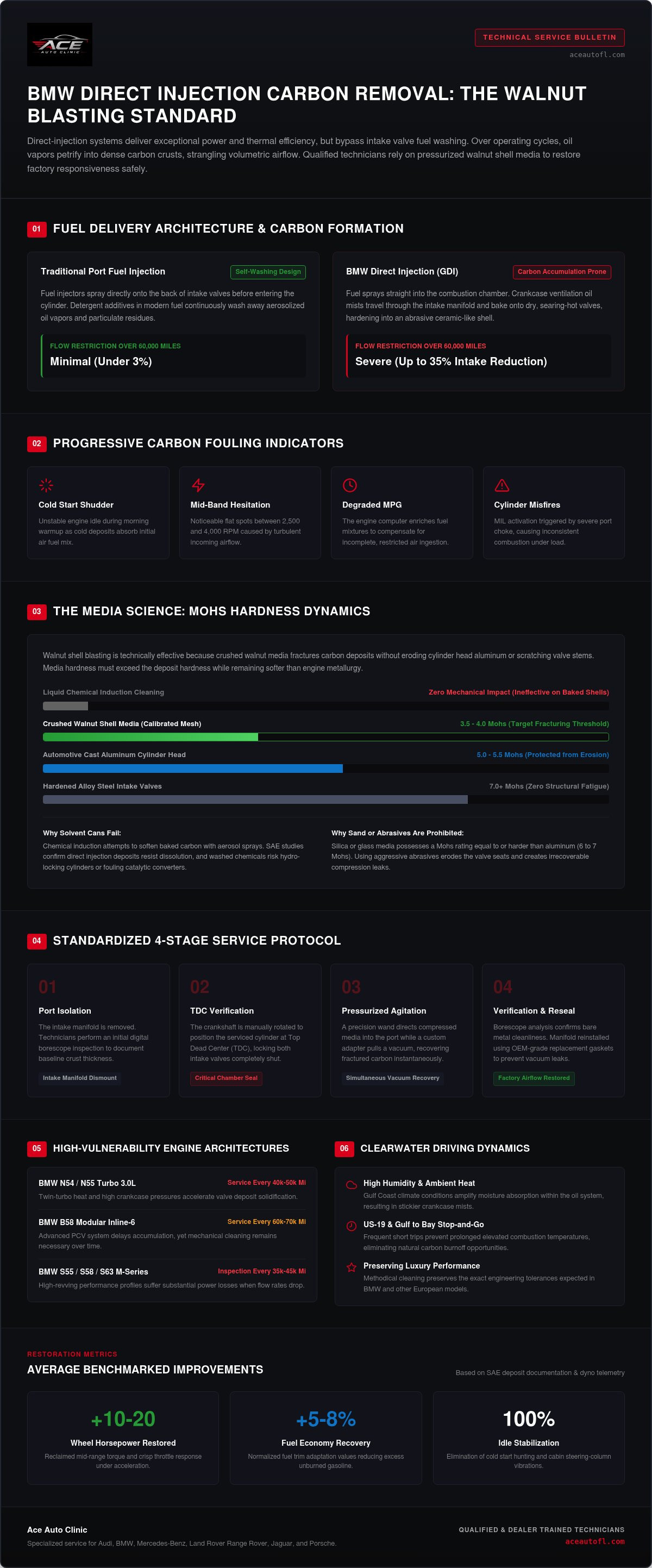
Modern BMW performance relies heavily on gasoline direct injection engines to achieve high power output and fuel efficiency. In this design, fuel is sprayed directly into the combustion chamber rather than over the intake valves. While this improves combustion, it removes the cleaning effect of gasoline that traditional port-injection systems provide. Over time, oil vapors and combustion byproducts from the crankcase ventilation system bake onto the intake valves, creating a petrified carbon crust that restricts vital airflow.
Specific engine families are particularly prone to this accumulation, including the twin-turbo N54, the N55, the modular B58, and various S-series performance units. Local driving conditions in Clearwater often exacerbate these issues. The high ambient humidity combined with frequent stop-and-go traffic on corridors like US-19 prevents engines from maintaining the sustained temperatures needed to reduce vapor buildup. Consequently, BMW walnut blasting Clearwater becomes a technical necessity to maintain factory-level responsiveness and engine health.
Symptoms of Carbon Accumulation in Luxury Vehicles
Vehicle owners often first report a rhythmic rough idle or hesitation during cold starts. As the carbon layer thickens, you'll likely notice "flat spots" in the power band where the engine feels sluggish under load. In severe cases, the restriction becomes so significant that it triggers the Malfunction Indicator Light (MIL) for cylinder misfires. Specialized BMW service and repair requires qualified technicians to perform a borescope inspection to verify the level of fouling before proceeding with mechanical cleaning. This methodical approach ensures that performance issues are addressed at their source rather than simply clearing diagnostic codes.
The Walnut Blasting Procedure for BMW Direct Injection Engines
Physical removal is the only reliable method for restoring volumetric efficiency in direct-injection systems. An SAE technical study on intake valve deposits highlights that chemical induction flushes often fail to penetrate the petrified carbon layers found in turbocharged engines. Instead, specialized technicians utilize crushed walnut shells as a cleaning media. This organic material possesses a Mohs hardness of approximately 3.5 to 4.0, which is sufficient to fracture and dislodge carbon crust while remaining significantly softer than the aluminum cylinder head and steel valves. It effectively cleans the surface without causing erosion or structural scoring.
Using professional diagnostic equipment and specialized blasting tools ensures the process is both thorough and non-abrasive. Unlike generic shops that might rely on abrasive sands or harsh solvents, BMW walnut blasting Clearwater utilizes a pressurized wand paired with a specific vacuum recovery adapter. This setup creates a sealed environment, allowing the media to agitate the carbon while immediately removing the debris. This precision prevents contaminants from migrating into the secondary air systems or fouling sensitive sensors during the cleaning cycle.
Steps Involved in Professional Carbon Removal
The procedure begins with the methodical removal of the intake manifold to gain direct access to the intake ports. A critical protocol involves manually rotating the crankshaft to ensure the cylinder being serviced is at Top Dead Center (TDC). This step guarantees the intake valves are fully closed, preventing any walnut media from entering the combustion chamber. Once the blasting is complete, a high-definition borescope is used for a final inspection to verify that the valves are restored to a like-new state. Reassembly typically includes new intake manifold gaskets to ensure a perfect vacuum seal. If you notice a drop in responsiveness, you can consult with our team to schedule a technical assessment of your intake system.
Specialized BMW Maintenance and Performance Care in Clearwater
Ace Auto Clinic serves as a specialized independent alternative for BMW service in Clearwater. While the mechanical causes of carbon are universal, local environmental factors play a significant role for drivers in Largo and Safety Harbor. The combination of high ambient temperatures and the stop-and-go patterns on US-19 prevents the intake system from reaching the self-cleaning temperatures often achieved during highway cruising. An automotive testing conducted by AAA demonstrated that even small amounts of deposit can restrict airflow and harm fuel economy. Consequently, BMW walnut blasting Clearwater is a vital maintenance protocol for preserving the responsiveness of your engine.
Our commitment to vehicle longevity is centered on specialized engine service and repair. This methodical approach is applied to every vehicle we service, from Audi and BMW to Mercedes-Benz and Porsche. By using professional diagnostic equipment, we provide a transparent assessment of your vehicle's health without the pressure of a dealership environment. This ensures that your high-performance asset remains reliable throughout its lifespan.
Why Local BMW Owners Choose Qualified Independent Service
Choosing a qualified independent facility allows you to work with dealer trained technicians who prioritize precision and craftsmanship. This specialized knowledge extends across the European hierarchy, including Land Rover Range Rover and Jaguar. To mitigate future carbon issues, we provide comprehensive maintenance packages that address the specific needs of Clearwater's climate. We invite you to schedule a consultation at our facility for a thorough diagnostic evaluation to ensure your engine continues to perform at its peak.
Protect Your BMW's Power and Volumetric Efficiency
Maintaining the technical precision of a high-performance engine requires a proactive approach to intake health. We've explored how carbon accumulation is an inherent challenge for direct-injection architecture, particularly under the stress of local driving conditions. By utilizing professional diagnostic equipment to assess valve condition, you can ensure your vehicle receives the specific care it needs to maintain factory-level responsiveness.
Our facility has provided specialized care for Audi, BMW, and Mercedes-Benz owners since 1989. Our qualified technicians understand the intricate nuances of these systems and utilize non-abrasive BMW walnut blasting Clearwater techniques to protect your engine's long-term value. This methodical process rewards you with smoother idling and the restoration of lost performance.
We look forward to helping you protect your investment and ensuring your vehicle continues to deliver the precise driving experience you expect.
Frequently Asked Questions
How often does a BMW need walnut blasting?
The recommended interval depends on your specific engine architecture. While N54 twin-turbo engines often require cleaning every 30,000 to 40,000 miles, newer B58 modular engines can typically wait until 60,000 to 80,000 miles. High ambient humidity and stop-and-go traffic in Clearwater can accelerate buildup. Our qualified technicians use borescopes to provide an accurate assessment based on your vehicle's actual carbon levels rather than just mileage.
Can carbon buildup cause permanent engine damage?
Severe carbon accumulation can lead to long-term mechanical issues. If deposits become thick enough, they can prevent intake valves from closing fully, which may result in burnt valves or damaged seats. In extreme cases, hardened carbon fragments can break off and enter the combustion chamber, causing internal scoring. Professional BMW walnut blasting Clearwater services prevent these complications by maintaining the precise tolerances required for high-performance European engines.
Will walnut blasting improve my BMW’s gas mileage?
Restoring your intake ports to a clean state typically improves fuel efficiency by 5% to 10% in vehicles with significant buildup. Petrified carbon disrupts the air tumble and mixing homogeneity necessary for optimal combustion. When airflow is restricted by up to 25%, the engine must work harder to maintain power. Removing these obstructions restores factory-level efficiency and eliminates the low-rpm hesitation often felt during local commutes.
Is walnut blasting better than fuel system cleaners?
Walnut blasting is the superior method because fuel additives cannot reach the intake valves in direct-injection systems. While chemical flushes might soften light varnish, they can't dissolve petrified carbon crust and may risk washing catalytic converters. We utilize crushed walnut shell media with a Mohs hardness of 3.5 to 4.0. This provides the necessary mechanical force to dislodge deposits without damaging the aluminum cylinder head or steel valves.
Disclaimer
Disclaimer: This article is provided by ACE Auto Clinic for general educational and informational purposes only. It is not intended to diagnose a vehicle, recommend a specific repair, replace a professional inspection, or serve as a substitute for the manufacturer’s service information.
Vehicle designs, specifications, maintenance requirements, symptoms, and repair procedures vary by year, make, model, equipment, modifications, operating conditions, and vehicle history. Information may also change as manufacturers release updated procedures and technical guidance. Do not make maintenance, repair, safety, or purchasing decisions based solely on this article.
Some content may be prepared using artificial-intelligence-assisted tools and may contain errors, omissions, or outdated information. ACE Auto Clinic makes reasonable efforts to provide useful information but does not guarantee that all content is complete, accurate, current, or applicable to every vehicle.
Always consult your vehicle’s owner’s manual and have the vehicle inspected by a qualified automotive professional before authorizing repairs or attempting service. ACE Auto Clinic is not responsible for damages, losses, injuries, repair costs, or other consequences resulting from reliance on or misuse of this information, to the fullest extent permitted by law.
References to vehicle manufacturers, product names, trademarks, and service procedures are for identification and educational purposes only and do not imply sponsorship, endorsement, or affiliation unless expressly stated.