While the luxury automotive market shifts toward hybridization, the Range Rover Diesel remains a pinnacle of towing efficiency and long-range torque for owners who prioritize sustained performance. Achieving approximately 30.1 miles per gallon in certain configurations, these vehicles offer a unique blend of utility and refinement that gasoline counterparts often struggle to match. You likely appreciate this efficiency, yet you may also feel concerned about the technical complexities of Diesel Exhaust Fluid (DEF) and Diesel Particulate Filter (DPF) systems.
We'll demonstrate how specialized maintenance ensures your SUV remains reliable for the long term. You'll discover the technical benefits of this specific powertrain and learn how to avoid common mechanical pitfalls, such as engine failure caused by improper oil standards. This guide provides a clear overview of how dealer trained technicians utilize precise diagnostic processes to maximize your vehicle's longevity and protect your investment.
Key Takeaways
- Understand the performance advantages of the Td6 powertrain, including its high torque output and superior towing capabilities for luxury utility.
- Identify the critical maintenance intervals for filtration and fluid systems that are unique to diesel engines to prevent costly engine repairs.
- Learn how specialized service for your Range Rover Diesel helps maximize fuel economy while protecting the vehicle against common mechanical pitfalls.
- Discover how the local Clearwater environment affects electrical components and why qualified technicians are essential for maintaining European vehicle standards.
The Appeal of the Range Rover Diesel: Torque and Efficiency
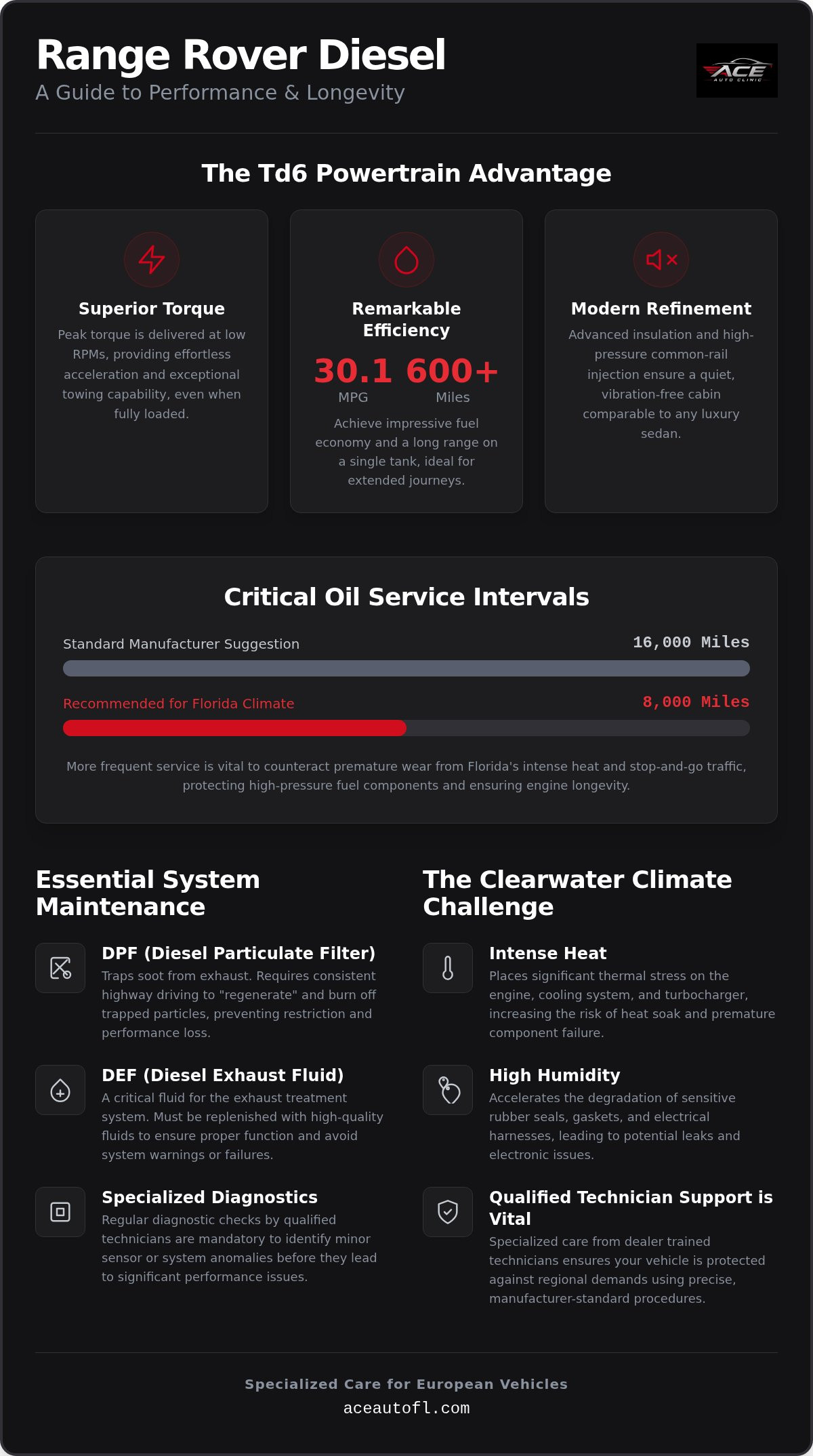
The Range Rover Diesel, particularly the Td6 variant, offers a unique balance of luxury and utility. Unlike its gasoline counterparts, the diesel engine provides peak torque at significantly lower revolutions. This characteristic allows for effortless acceleration from a standstill, which is particularly beneficial when the vehicle is loaded with passengers or towing heavy equipment. In highway conditions, this efficiency is even more pronounced. Owners of the 3.0L V6 turbo diesel often achieve approximately 30.1 miles per gallon, which can translate to over 600 miles on a single tank. This capability significantly reduces the frequency of stops during long-range travel.
Refinement is another hallmark of the modern Range Rover Diesel. Throughout the History of the Range Rover, the brand has continually improved its powertrain smoothness. Current diesel systems utilize advanced insulation and high-pressure common-rail injection to ensure the cabin remains as quiet as any luxury sedan. This evolution means owners don't have to compromise on comfort to gain the benefits of diesel longevity. The sophisticated design of these modern systems has effectively eliminated the noise and vibration once associated with older diesel technology.
Understanding the Td6 Engine Architecture
The 3.0-liter Td6 engine utilizes a variable geometry turbocharger to optimize power across the entire RPM range. This technology adjusts the flow of exhaust gases to the turbine, providing immediate boost and minimizing lag. The engine's durability stems from its construction; the blocks are made from compacted graphite iron. This material offers superior strength over traditional aluminum while remaining lightweight. Qualified technicians at a specialized Jaguar, Land Rover & Range Rover Service & Repair facility understand that these components require meticulous care. Because the tolerances are so tight, using precise oil standards and high-quality filters is essential for maintaining engine health.
Essential Maintenance for Range Rover Diesel Longevity
Maintaining a Range Rover Diesel requires a shift in perspective compared to gasoline models. While the mechanical efficiency is superior, the complexity of modern clean diesel engines demands a disciplined, proactive approach. Standard service intervals often suggest 16,000 miles, yet for vehicles subjected to Florida's intense heat and stop-and-go traffic, qualified technicians recommend intervals closer to 8,000 miles. This frequency ensures that specialized engine oil remains within its protective specifications and prevents the premature wear of high-pressure fuel injection components.
Specialized diagnostics are mandatory for monitoring the health of the fuel delivery system. Minor sensor malfunctions or small leaks in the air intake can lead to significant performance degradation. Through regularly scheduled inspections, we identify these anomalies before they compromise the engine's reliability. This methodical oversight is the most effective way to prevent the high costs associated with specialized European vehicle parts.
Managing the DPF and DEF Systems
The Diesel Particulate Filter (DPF) is a precision component designed to trap soot. It requires consistent highway driving to complete its regeneration cycle and burn off accumulated particulates. If your Range Rover Diesel is primarily used for short commutes, the filter may become restricted. Additionally, Diesel Exhaust Fluid (DEF) must be replenished with high-quality fluids to ensure the exhaust treatment system functions correctly. Our oil and fluid testing can detect early signs of fuel dilution or fluid contamination within these complex systems. If you have questions about your specific maintenance schedule, you can consult with our specialized staff to ensure your SUV remains in peak condition.
Specialized Care for Range Rover Owners in Clearwater
Clearwater's environmental profile creates unique challenges for European luxury vehicles. High humidity and ambient heat often accelerate the degradation of rubber seals and sensitive electrical harnesses. Because the Range Rover Diesel operates at higher internal temperatures than its gasoline counterparts, this thermal stress is particularly impactful. Adhering to Essential diesel engine maintenance standards is vital to ensure that these heat-sensitive components don't fail prematurely.
Owners throughout the Gulf Coast benefit from a Jaguar and Land Rover repair specialist who understands these regional demands. Since 1989, Ace Auto Clinic has provided a sophisticated alternative to high dealership service prices. Our dealer trained technicians utilize professional diagnostic equipment to ensure every repair meets precise manufacturer standards. We focus on meticulous care for pre-owned diesel models, ensuring their high torque output remains consistent despite the rigors of the Florida climate.
Why Qualified Technician Support is Vital in Florida
Intense heat places additional stress on the cooling system and the specialized turbochargers found in diesel engines. Without adequate cooling, these precision components can suffer from heat soak, leading to performance loss or mechanical failure. Preventative engine service and repair is essential for maintaining the reliability of high-value luxury SUVs. Clearwater owners can rely on our transparent communication and thorough inspection processes to protect their investment and maintain the peak performance expected of the Land Rover brand.
Securing the Longevity of Your Range Rover Diesel
Maintaining a Range Rover Diesel requires a methodical approach that balances performance with protection. You now understand that monitoring the filtration and fluid systems is essential for preventing exhaust treatment failures, while adhering to precise oil standards protects internal engine tolerances. It's through this specialized care that you ensure your SUV continues to deliver its signature torque despite the demanding Florida environment.
Established in 1989, Ace Auto Clinic has served the Clearwater community for over three decades. As a fourth-generation family-owned facility, we prioritize technical accuracy and professional trust. Our dealer trained technicians understand the nuances of Land Rover engineering and use professional diagnostic equipment to protect your vehicle's value.
We look forward to helping you maintain the reliability of your high-value asset.
Frequently Asked Questions
How often does a Range Rover Diesel need an oil change?
For a Range Rover Diesel, the manufacturer officially recommends an oil change every 16,000 miles or 12 months. However, qualified technicians in the Clearwater area advise a shorter interval of 8,000 to 10,000 miles for vehicles used for towing or frequent stop-and-go driving. Proactive maintenance is essential to prevent soot accumulation and maintain the tight tolerances of the high-pressure fuel system.
What happens if I run out of Diesel Exhaust Fluid (DEF)?
If your vehicle completely runs out of Diesel Exhaust Fluid, the engine will enter a restricted performance mode and eventually refuse to restart until the reservoir is replenished. This safety feature ensures the Selective Catalytic Reduction system remains functional. Our dealer trained technicians can perform a full system scan to ensure no sensors were compromised during the fluid depletion and provide high-quality fluid top-offs.
Is the Range Rover Diesel better for towing than the gasoline version?
The Range Rover Diesel is generally considered superior for towing because it delivers peak torque at much lower engine speeds than gasoline variants. For example, the Td6 engine provides effortless pulling power without needing to downshift frequently on inclines. This characteristic reduces stress on the transmission and cooling system, making it a more stable and efficient choice for Clearwater owners hauling heavy trailers or boats.
Do diesel Range Rovers have more mechanical issues than gasoline models?
Diesel models aren't necessarily less reliable, but they require a different maintenance philosophy focused on exhaust treatment and fuel purity. While gasoline engines may face ignition coil wear, the Range Rover Diesel requires specialized care for the DPF and fuel injectors. When serviced by qualified professionals using precise diagnostic equipment, these engines often demonstrate greater long-term durability and higher mileage potential than their gasoline counterparts.
Disclaimer
Disclaimer: This article is provided by ACE Auto Clinic for general educational and informational purposes only. It is not intended to diagnose a vehicle, recommend a specific repair, replace a professional inspection, or serve as a substitute for the manufacturer’s service information.
Vehicle designs, specifications, maintenance requirements, symptoms, and repair procedures vary by year, make, model, equipment, modifications, operating conditions, and vehicle history. Information may also change as manufacturers release updated procedures and technical guidance. Do not make maintenance, repair, safety, or purchasing decisions based solely on this article.
Some content may be prepared using artificial-intelligence-assisted tools and may contain errors, omissions, or outdated information. ACE Auto Clinic makes reasonable efforts to provide useful information but does not guarantee that all content is complete, accurate, current, or applicable to every vehicle.
Always consult your vehicle’s owner’s manual and have the vehicle inspected by a qualified automotive professional before authorizing repairs or attempting service. ACE Auto Clinic is not responsible for damages, losses, injuries, repair costs, or other consequences resulting from reliance on or misuse of this information, to the fullest extent permitted by law.
References to vehicle manufacturers, product names, trademarks, and service procedures are for identification and educational purposes only and do not imply sponsorship, endorsement, or affiliation unless expressly stated.