A generic code reader might tell you what happened, but it rarely explains why your Audi responded that way. You've likely experienced a sense of concern regarding reliability when an amber warning illuminates on your dashboard while navigating the Florida heat. It's frustrating to face the prospect of high dealership costs or the uncertainty of a generalist repair shop that lacks brand-specific tools. We understand that you value the performance and longevity of your vehicle above all else.
This guide explains why your Audi check engine light Clearwater is active and how specialized diagnostic equipment preserves the precision engineering of your vehicle. We'll examine common triggers such as carbon buildup and ignition sensitivity. You'll also learn how qualified, dealer trained technicians provide the technical accuracy needed to maintain your vehicle value and your peace of mind regarding safety on the road.
Key Takeaways
- Identify common mechanical triggers such as faulty oxygen sensors or carbon buildup that affect Audi engine performance.
- Recognize the technical differences between basic OBD-II scanners and the specialized diagnostic tools used by qualified technicians.
- Address an Audi check engine light Clearwater quickly to prevent the Florida heat from damaging sensitive intake and cooling components.
- Leverage the knowledge of dealer trained technicians at a family owned establishment to maintain the integrity of your European vehicle.
Decoding the Audi Check Engine Light and Common Trigger Points
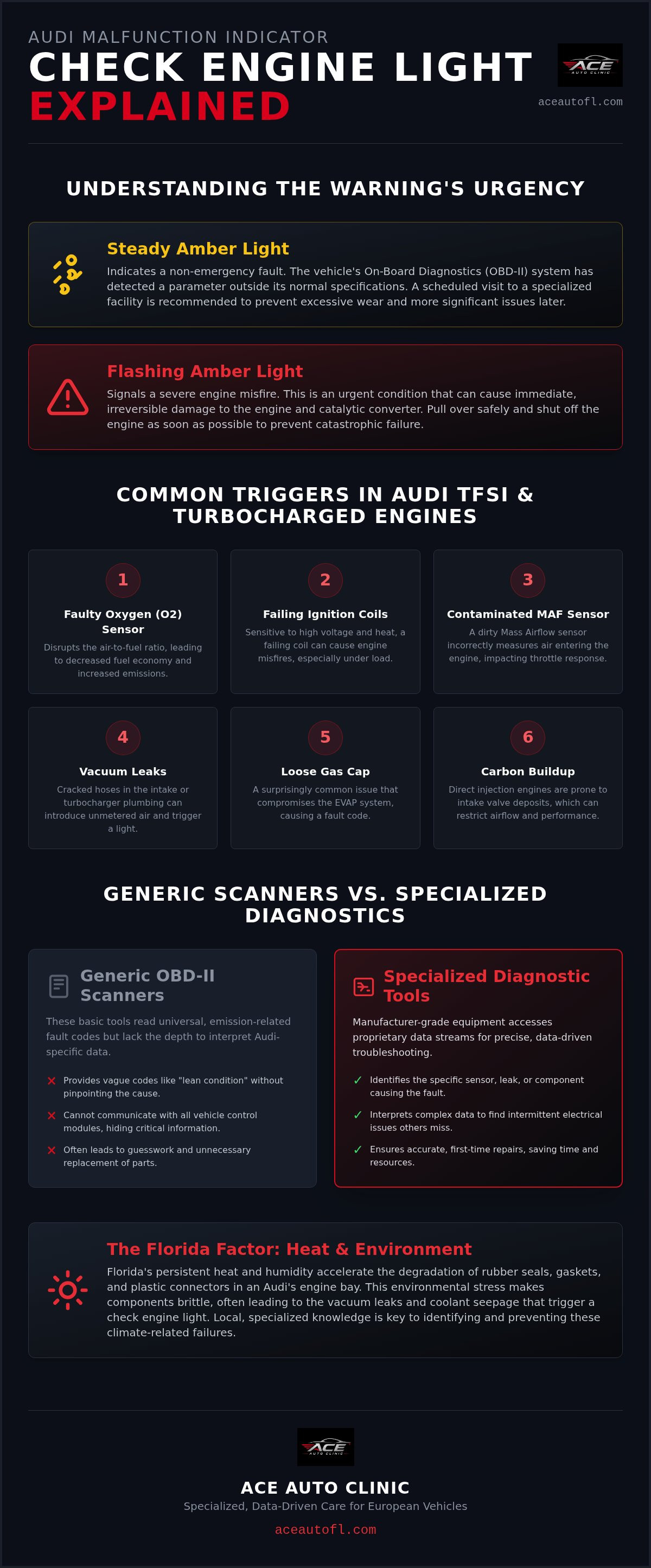
The Malfunction Indicator Light (MIL) is the primary communication link between your vehicle's computer and the driver. This light is part of the On-Board Diagnostics (OBD-II) system, which monitors engine health and emission levels. When you see an Audi check engine light Clearwater, it indicates the system has detected a parameter outside of its factory specifications. This sophisticated monitoring ensures that minor mechanical variances don't escalate into catastrophic failures.
Audi models with direct injection, such as those featuring TFSI or turbocharged engines, often trigger warnings due to specific mechanical sensitivities. Common culprits include:
- Faulty oxygen (O2) sensors that disrupt air-to-fuel ratios.
- Failing ignition coils that are sensitive to high voltage and ambient heat.
- Contaminated mass airflow (MAF) sensors that impact throttle response.
- Vacuum leaks within the intake manifold or turbocharger plumbing.
A loose gas cap is a frequent minor fault that compromises the evaporative emission (EVAP) system. While it's a simple fix, ignoring any malfunction indicator light leads to decreased fuel economy and potential catalytic converter damage over time.
Identifying Serious Symptoms vs Minor Faults
The behavior of the dashboard light dictates the urgency of the situation. A steady amber light typically suggests a non-emergency fault that requires a scheduled visit to a specialized facility. This allows qualified technicians to address the issue before it causes excessive wear. A flashing light indicates a severe engine misfire. This condition can cause immediate, irreversible damage to internal engine components and the exhaust system. We recommend pulling over safely if the light begins to flash. Taking this immediate action protects your engine and transmission from significant failure while maintaining the long-term value of your luxury vehicle.
Specialized Diagnostics vs Generic OBD-II Scanners
Generic OBD-II scanners found at local auto parts stores are designed to read basic emission-related codes. While these tools provide a starting point, they often fail to interpret the intricate electrical architecture found in European vehicles. When an Audi check engine light Clearwater appears, a standard code reader might suggest a generic "lean condition" without identifying the specific sensor or vacuum leak responsible. Specialized diagnostic equipment allows our technicians to access manufacturer-specific data streams. This level of detail is necessary for accurate troubleshooting and prevents the common practice of replacing parts based on guesswork. By focusing on data-driven results, we ensure that every repair is both necessary and effective.
The Importance of Accurate Data Retrieval
European vehicles utilize proprietary communication protocols that require specific software interfaces for full system access. Standard tools cannot communicate with every control module, often leaving critical information hidden within the vehicle's memory. Our dealer trained technicians interpret these complex data points to identify intermittent electrical faults that generic shops frequently overlook. This precision is vital for maintaining the high performance and safety standards expected of a luxury vehicle. Understanding your consumer rights in auto repair includes knowing that you can choose specialized independent facilities that match dealership capabilities without compromising your vehicle integrity.
Accurate data retrieval ensures that the root cause of a malfunction is addressed during the first visit. This methodical approach protects the long-term health of your engine while respecting your time and resources. You can learn more about our specialized Audi service and repair to see how we maintain these high standards. If you have questions about a specific warning on your dashboard, please reach out to our service advisors for professional guidance.
Resolving Engine Warnings with Specialized Care in Clearwater
Ace Auto Clinic has served the Clearwater community since 1989 with a steadfast focus on integrity and professional automotive care. As a fourth-generation family-owned facility, we've served local drivers with the technical precision their luxury vehicles require. Addressing an Audi check engine light Clearwater requires a deep understanding of how our coastal environment impacts German engineering. The persistent Florida heat frequently accelerates the wear of rubber seals and plastic connectors within the Audi cooling and intake systems. These components often become brittle over time, leading to vacuum leaks or coolant seepage that triggers the dashboard warning. Our specialized approach provides a dealership-level experience with the personal, transparent service of a local independent shop.
We prioritize technical accuracy to protect your vehicle's long-term performance and resale value. You can explore our malfunction indicator light diagnostics to see how we use manufacturer-grade tools to read proprietary data. This ensures that we address the root cause of a fault rather than simply clearing a code. It's essential to address these warnings early to prevent minor sensor issues from becoming major mechanical failures.
Proactive Maintenance to Prevent Warning Lights
Regular oil and fluid analysis can identify early signs of engine wear before they trigger a formal warning light. By examining the condition of your lubricants, we can detect thermal breakdown or metal particulates that suggest impending issues. Our maintenance packages are specifically tailored for Clearwater drivers, helping to ensure reliability during the most demanding high-temperature months of the year. Check out our guide on European auto repair in Clearwater FL for more maintenance tips. These specialized services are designed to maintain the mechanical integrity and safety standards of your luxury vehicle, ensuring it remains a reliable asset for years to come.
Protect Your Audi's Performance and Value
Maintaining the sophisticated engineering of your vehicle requires more than a generic code reset. Addressing an Audi check engine light Clearwater early ensures that minor sensor faults don't lead to expensive repairs. Our qualified, dealer trained technicians utilize specialized equipment to interpret manufacturer-specific data streams, providing the same level of precision you expect from a dealership.
Since 1989, our fourth-generation family-owned shop has prioritized the integrity of European luxury vehicles. By choosing professional diagnostics, you safeguard your engine against the harsh effects of the Florida climate while maintaining long-term reliability. We invite you to experience the difference that specialized knowledge and transparent service make for your vehicle.
Ensuring your safety and vehicle longevity is our primary objective.
Frequently Asked Questions
Is it safe to drive my Audi with the check engine light on?
If the light is steady and the vehicle feels normal, you can typically drive to a service facility. However, you should address an Audi check engine light Clearwater promptly to prevent secondary damage. A steady light often indicates a sensor fault that, if ignored, can reduce fuel efficiency and eventually harm your catalytic converter or other sensitive engine components.
How much does an Audi diagnostic service cost in Clearwater?
The cost of a diagnostic service varies depending on the complexity of the electrical system and the time required for testing. Professional evaluations by qualified technicians involve using manufacturer-specific software to access deep system data. We recommend contacting a specialized facility for an estimate, as accurate troubleshooting prevents the unnecessary expense of replacing functional parts based on generic error codes.
Can a loose gas cap really cause a check engine light in an Audi?
A loose or damaged gas cap is a very common trigger for engine warnings. This component is part of the evaporative emission system, which prevents fuel vapors from escaping into the atmosphere. If the cap isn't sealed, the computer detects a pressure leak and illuminates the light. If tightening the cap doesn't resolve the issue, specialized equipment can identify other potential leaks.
Why is my Audi check engine light flashing?
A flashing light indicates a severe engine misfire that requires immediate attention. This condition allows unburned fuel to enter the exhaust system, potentially causing permanent damage to the catalytic converter within minutes. If this occurs, you should pull over safely and stop the engine. Our dealer trained technicians must perform a comprehensive analysis of the ignition and fuel systems to ensure your safety.
Disclaimer
Disclaimer: This article is provided by ACE Auto Clinic for general educational and informational purposes only. It is not intended to diagnose a vehicle, recommend a specific repair, replace a professional inspection, or serve as a substitute for the manufacturer’s service information.
Vehicle designs, specifications, maintenance requirements, symptoms, and repair procedures vary by year, make, model, equipment, modifications, operating conditions, and vehicle history. Information may also change as manufacturers release updated procedures and technical guidance. Do not make maintenance, repair, safety, or purchasing decisions based solely on this article.
Some content may be prepared using artificial-intelligence-assisted tools and may contain errors, omissions, or outdated information. ACE Auto Clinic makes reasonable efforts to provide useful information but does not guarantee that all content is complete, accurate, current, or applicable to every vehicle.
Always consult your vehicle’s owner’s manual and have the vehicle inspected by a qualified automotive professional before authorizing repairs or attempting service. ACE Auto Clinic is not responsible for damages, losses, injuries, repair costs, or other consequences resulting from reliance on or misuse of this information, to the fullest extent permitted by law.
References to vehicle manufacturers, product names, trademarks, and service procedures are for identification and educational purposes only and do not imply sponsorship, endorsement, or affiliation unless expressly stated.