Why should a precision-engineered braking system designed for the Nürburgring sound like a freight train when you pull into your driveway? Many owners find themselves frustrated by persistent squealing or high-speed vibrations, only to be told these issues are a normal byproduct of high-performance engineering. While Porsche brakes are indeed robust, these symptoms often indicate specific maintenance needs that require a specialized touch rather than a dismissive explanation. If you are seeking professional porsche brake repair clearwater, it's essential to distinguish between expected mechanical behavior and genuine component fatigue.
We understand that maintaining a Porsche involves a meticulous balance of performance and preservation. This article provides an expert-led technical checklist to help you identify when your pads have reached the critical 3mm replacement threshold or when your brake fluid exceeds the 2% moisture limit. You will learn how a diagnostic-led approach eliminates unnecessary parts replacement and addresses the high costs often associated with ceramic systems. By following this specialist guide, you can ensure your vehicle maintains its legendary stopping power while building a relationship with a local expert dedicated to precision maintenance and technical mastery.
Key Takeaways
- Learn to differentiate between standard high-performance brake noise and critical mechanical wear to ensure your vehicle remains safe and responsive.
- Understand the technical inspection process for monobloc calipers and rotor thickness to prevent premature component failure and maintain factory performance.
- Discover why specialized diagnostic software is required for porsche brake repair clearwater to properly service integrated ABS and PSM systems.
- Evaluate the performance benefits of using OEM or premium aftermarket components like Brembo and Pagid for consistent, reliable stopping power.
- Identify early indicators of heat-related discoloration and seal integrity issues before they lead to extensive hydraulic system repairs.
Recognizing Porsche Braking System Warning Signs
Understanding the nuances of a high-performance braking system requires a specialized perspective. While standard vehicles may provide obvious cues for maintenance, a Porsche communicates through more subtle technical feedback. For owners seeking porsche brake repair clearwater, recognizing these early indicators prevents minor wear from evolving into a safety compromise or a costly mechanical failure. Precision is the hallmark of the Porsche brand; your maintenance approach should be no different.
Dashboard Indicators and Sensors
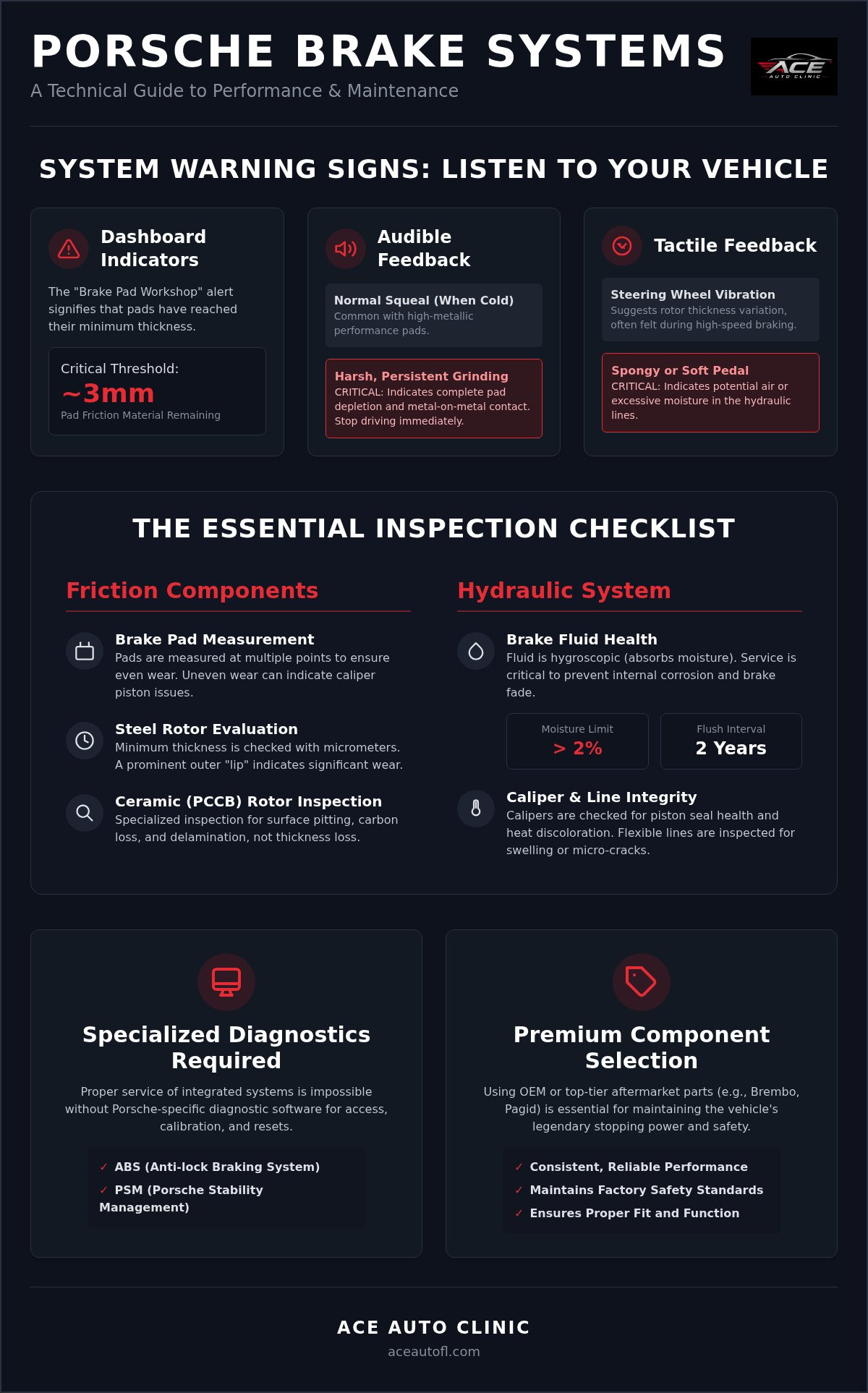
Modern Porsches utilize sophisticated electronic wear sensors embedded within the brake pads. When the friction material reaches a critical thickness, typically around 3mm, the sensor makes contact with the rotor and completes an electrical circuit. This triggers the "Brake Pad Workshop" alert or a similar warning on your instrument cluster. Because these sensors are integrated into the vehicle's complex electronic architecture, a glowing indicator requires immediate professional malfunction indicator light diagnostics to confirm the specific axle requiring service and to ensure the system is properly reset after the repair.
Audible and Tactile Feedback
Distinguishing between normal operation and system failure is vital for any enthusiast. High-performance brake pads often produce a slight squeal when cold due to their high metallic content and friction coefficient. This is typically a byproduct of racing-derived engineering. However, a persistent, harsh grinding sound indicates the pad material is fully depleted, leading to metal-on-metal contact that will quickly destroy the rotors. Tactile feedback provides further clues to the system's health. If you experience steering wheel vibration during high-speed deceleration, it often points to rotor thickness variation. A spongy or soft brake pedal is even more critical; it suggests air in the lines or excessive moisture in the fluid. The ABS system also provides specific feedback. While a rapid pulsing in the pedal is expected during emergency stops to prevent wheel lockup, that same sensation during routine, light braking suggests a mechanical irregularity in the rotors that requires a specialist's intervention.
The Essential Porsche Brake Inspection Checklist
A technical inspection of a high-performance braking system requires more than a cursory visual scan. It demands a methodical approach using precise instruments to ensure every component meets the exacting standards of Stuttgart engineering. For those prioritizing porsche brake repair clearwater, this checklist serves as the foundation for maintaining vehicle safety and mechanical integrity. Precision here isn't just about performance; it's about the long-term preservation of your vehicle's hydraulic and friction systems.
Rotor and Pad Evaluation
Standard steel rotors are measured for minimum thickness using micrometers to ensure they remain within factory tolerances. These rotors often develop a prominent "lip" at the outer edge as they wear, which can cause pad misalignment or persistent noise. Porsche Ceramic Composite Brakes (PCCB) require a specialized diagnostic approach. Unlike steel, PCCB rotors don't typically lose thickness; instead, they are inspected for surface pitting, carbon loss, or delamination. Friction pads must be measured at multiple points to ensure even wear across the inner and outer surfaces. If you've noticed uneven wear patterns, it's often a sign of piston drag within the caliper, and you should connect with a technician for a comprehensive evaluation.
Hydraulic System and Fluid Health
Porsche specifies a complete brake fluid flush every two years regardless of mileage. Brake fluid is hygroscopic, which means it actively absorbs moisture from the atmosphere. In the humid Clearwater environment, this contamination can happen rapidly. When moisture content exceeds 2%, the fluid's boiling point drops, potentially leading to brake fade during high-demand scenarios. We utilize specialized oil and fluid testing to accurately determine contamination levels and prevent internal corrosion of the ABS and PSM modules.
The inspection concludes with a detailed look at the monobloc calipers and flexible lines. Calipers are checked for piston seal integrity and heat-related discoloration, often referred to as "temping," which indicates the system has reached extreme temperatures. Flexible rubber brake lines are scrutinized for swelling or micro-cracks, which are frequently exacerbated by intense Florida heat and UV exposure. Ensuring these components are sound is vital for maintaining the firm, confidence-inspiring pedal feel that defines the Porsche driving experience.
Selecting a Specialist for Porsche Brake Repair in Clearwater
Selecting a facility for porsche brake repair clearwater is a decision that directly influences both vehicle longevity and your confidence behind the wheel. It's not merely a matter of component replacement; it's about finding a technician who understands the specific weight distribution and cooling requirements of mid-engine and rear-engine configurations. A specialist must possess the technical depth to perform integrated suspension and brakes repair, as these systems are fundamentally linked in high-performance applications. When one system is serviced, the other must be inspected to ensure the vehicle's handling remains balanced and predictable.
The Importance of Specialized Tooling
Modern Porsche hydraulic circuits are exceptionally complex. Standard generic scanners often fail to communicate with the vehicle's proprietary modules or reset service intervals correctly, leading to persistent dashboard alerts. A true specialist utilizes Porsche-specific diagnostic software to interact with the ABS and PSM systems during the bleeding process. This software is required to cycle the valves within the ABS pump, ensuring no air remains trapped in the intricate pathways of the hydraulic system. This level of precision is the only way to maintain the firm, immediate pedal feel essential for spirited driving.
Personalized Maintenance Planning
Every Porsche is driven differently, so a one size fits all approach to service is insufficient. Whether you prioritize daily commuting or weekend track sessions, your braking needs will vary significantly. We develop custom plans through vehicle maintenance packages tailored to your specific usage patterns. This includes choosing between genuine OEM parts or high-performance components from manufacturers like Brembo or Pagid, which offer different thermal thresholds and friction coefficients. For those considering a new acquisition, a detailed report following a pre-purchase inspection is the most reliable way to verify the current state of the braking system. This documentation provides a transparent look at pad life and rotor health, allowing you to plan for future maintenance with absolute certainty.
Preserving Your Porsche's Performance Standards
Maintaining the technical excellence of your Porsche requires a commitment to diagnostic precision and factory-grade specifications. As established, early detection of pad wear and moisture contamination is the most effective way to prevent costly component failure or compromised safety. By prioritizing specialized porsche brake repair clearwater, you ensure that every element of the hydraulic and friction system operates within the strict tolerances defined by the manufacturer. This methodical approach preserves the vehicle's balance and the tactile feedback that drivers expect from the brand.
Since 1989, our team has served the Clearwater community with a focus on specialized European and luxury vehicle diagnostics. We understand that these machines require a meticulous approach that generalist shops simply can't provide. Whether you're addressing a dashboard alert or preparing for a weekend drive, professional oversight is the key to long-term reliability and peak performance.
Our goal is to help you maintain the confidence that comes with peak mechanical mastery. We look forward to assisting you in the preservation of your vehicle's legendary stopping power and overall driving integrity.
Frequently Asked Questions
How often do Porsche brake pads typically need replacement?
Porsche brake pads require replacement once the friction material reaches a thickness of 3mm. While mileage varies based on your driving environment and habits, a Porsche Taycan can often achieve 60,000 to 80,000 miles on original pads due to regenerative braking. For those seeking porsche brake repair clearwater, a technical inspection is the only reliable way to determine your specific replacement interval based on current wear patterns and rotor condition.
Why are my Porsche brakes squeaking even though the pads are new?
Squeaking in new Porsche brakes is frequently caused by the high metallic content of performance pads or an incomplete bedding-in process. This noise occurs when high-frequency vibrations are transmitted through the caliper during light braking. If the noise persists after several heat cycles, it may indicate a need for anti-squeal shims or a specialized lubricant on the pad backing plates. Professional technicians can verify if the noise is a standard performance characteristic or a mechanical misalignment.
Can I replace just the brake pads if my rotors look okay?
While it is possible to replace only the pads, Porsche typically recommends replacing pads and rotors together to ensure optimal friction and prevent vibration. Installing new pads on worn rotors often leads to reduced stopping power and pedal pulsation because the new pad cannot perfectly contour to a used rotor surface. Because Porsche rotors are designed to be lightweight and high-friction, they often reach their minimum thickness specification near the same time as the pads.
What is the difference between Porsche steel brakes and PCCB in terms of maintenance?
The primary difference lies in the inspection method; steel rotors are measured for thickness, while Porsche Ceramic Composite Brakes (PCCB) are evaluated for weight and surface integrity. Standard iron rotors are prone to thinning and warping over time. Conversely, PCCB rotors are designed for extreme longevity but are susceptible to surface pitting or delamination if used heavily. Specialized porsche brake repair clearwater involves using specific diagnostic tools to assess PCCB health without causing accidental damage to the ceramic surface.
Disclaimer
Disclaimer: This article is provided by ACE Auto Clinic for general educational and informational purposes only. It is not intended to diagnose a vehicle, recommend a specific repair, replace a professional inspection, or serve as a substitute for the manufacturer’s service information.
Vehicle designs, specifications, maintenance requirements, symptoms, and repair procedures vary by year, make, model, equipment, modifications, operating conditions, and vehicle history. Information may also change as manufacturers release updated procedures and technical guidance. Do not make maintenance, repair, safety, or purchasing decisions based solely on this article.
Some content may be prepared using artificial-intelligence-assisted tools and may contain errors, omissions, or outdated information. ACE Auto Clinic makes reasonable efforts to provide useful information but does not guarantee that all content is complete, accurate, current, or applicable to every vehicle.
Always consult your vehicle’s owner’s manual and have the vehicle inspected by a qualified automotive professional before authorizing repairs or attempting service. ACE Auto Clinic is not responsible for damages, losses, injuries, repair costs, or other consequences resulting from reliance on or misuse of this information, to the fullest extent permitted by law.
References to vehicle manufacturers, product names, trademarks, and service procedures are for identification and educational purposes only and do not imply sponsorship, endorsement, or affiliation unless expressly stated.