Could the humid Clearwater climate be quietly compromising the precision of your 911 or Cayenne? Many owners notice a subtle loss in engine responsiveness over time and worry that general repair shops lack the technical depth to restore that factory feel. Porsche performance maintenance is more than a routine service; it's a meticulous discipline required to protect a high-value asset. We agree that your vehicle deserves a level of care that matches its engineering, especially when Florida heat can reduce battery life to just two or three years. This guide explains how specialized maintenance and precision diagnostics preserve the signature handling and power of your Porsche. You will learn about the necessity of PIWIS 4 diagnostic integration, the importance of N-specification tires, and how qualified, dealer trained technicians ensure your vehicle maintains its peak performance and resale value.
Key Takeaways
- Learn how specialized diagnostic platforms allow qualified technicians to identify minor timing and fuel delivery variances before they impact the driving experience.
- Understand the vital role that bushings, dampers, and steering rack integrity play in preserving the signature handling and braking precision of your vehicle.
- Discover why the Clearwater climate necessitates proactive cooling system inspections to protect precision engines from the effects of high ambient temperatures.
- Identify the proactive service intervals required for Porsche performance maintenance to ensure peak engine responsiveness and protect long-term resale value.
The Role of Specialized Diagnostics in Porsche Performance
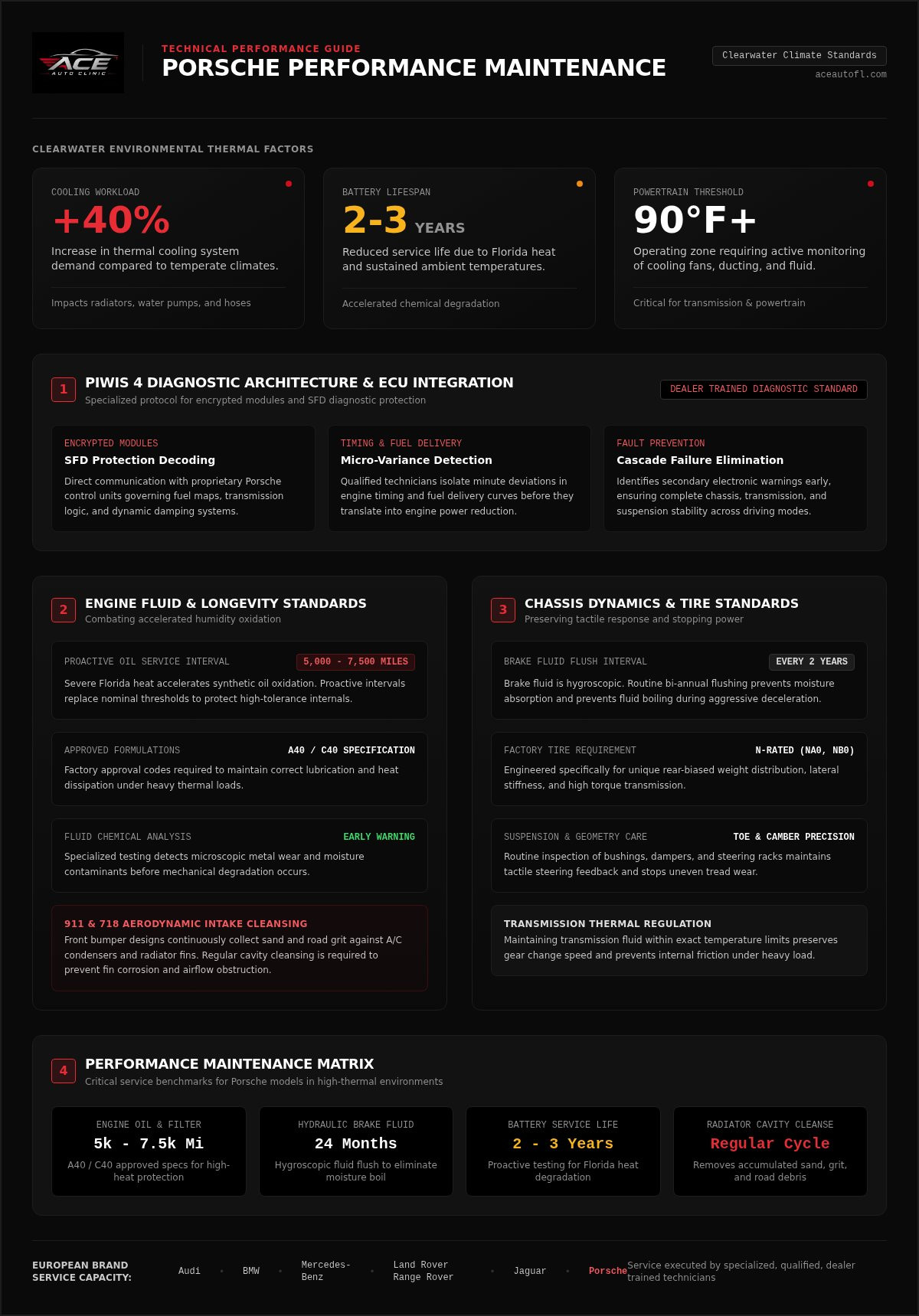
Porsche performance maintenance depends on a complex network of electronic control units (ECUs) that govern everything from fuel maps to suspension damping. Unlike generic systems, modern Porsche platforms utilize encrypted modules and SFD diagnostic protection that require specialized equipment like the PIWIS 4 system. Qualified technicians use these tools to interpret raw data from on-board diagnostics, identifying minor variances in engine timing or fuel delivery before they manifest as performance loss. Regular diagnostic scans ensure that the sophisticated software managing your transmission and suspension remains optimized for local conditions. This proactive approach prevents the cascade of mechanical failures often triggered by ignored warning lights, preserving the vehicle's integrity through technical precision.
Advanced Oil and Fluid Analysis for Engine Longevity
Precision engines require lubricants that meet exact manufacturer approval codes, such as A40 or C40 formulations, to maintain internal temperature and lubrication. Implementing oil and fluid testing allows experienced technicians to detect microscopic metal wear or contaminants that standard inspections might miss. This data-driven method provides a clear picture of engine health and helps specialized shops recommend proactive service intervals, often between 5,000 and 7,500 miles, tailored to your specific Clearwater driving habits. By analyzing chemical composition, specialized staff ensure the engine remains protected against the accelerated oxidation caused by Florida humidity. These tests act as an early warning system for internal components, allowing for targeted repairs that maintain the long-term resale value of your vehicle.
Precision Maintenance for Braking and Suspension Systems
The legendary handling of a Porsche is a product of meticulously engineered components working in unison. Maintaining the integrity of bushings, dampers, and the steering rack is essential for preserving tactile feedback. Specialized suspension care involves identifying subtle hydraulic leaks or rubber fatigue that can degrade steering precision. Beyond stopping power, brake performance relies on effective heat dissipation and consistent pedal feel. Because brake fluid is hygroscopic, a professional brake fluid flush every two years is necessary to prevent boiling under high thermal loads. Regular suspension and brakes repair is a pillar of Porsche performance maintenance that ensures the vehicle remains predictable. If you've noticed a change in chassis response, it's wise to schedule an inspection with qualified technicians.
Tire Standards and Wheel Alignment for Performance
Porsches require N-rated tires specifically designed to manage unique weight distribution and high torque loads. These tires carry proprietary markings like NA0 or NB0, confirming they meet strict chassis balance requirements. Utilizing professional tire and wheel services prevents uneven tread wear and maintains the intended contact patch. Precision alignment is equally critical. Even a minor deviation in toe or camber can cause the car to track poorly or respond sluggishly. This level of Porsche performance maintenance protects your investment while ensuring the vehicle handles exactly as intended. While we apply this same rigor to Audi, BMW, and Mercedes-Benz vehicles, the specific geometry of a Porsche requires a specialized touch.
Managing Engine Health and Reliability in the Florida Heat
The Clearwater climate imposes a 40 percent increase in thermal cooling system workload compared to temperate regions. This environmental stress makes Porsche performance maintenance a year-round priority. Specialized technicians inspect coolant hoses, radiators, and water pumps for signs of fatigue caused by sustained high ambient temperatures. Because engine oil oxidizes faster in extreme heat, adhering to high-quality manufacturer standards is essential for protecting internal components. A comprehensive Porsche service and repair plan also includes verifying the integrity of the A/C system, which manages cabin comfort and helps regulate secondary component temperatures.
Front bumper intake designs on 911 and 718 models continuously accumulate sand and road grit. This debris builds up against air-conditioning condensers and radiator fins, making regular bumper cavity cleansing essential to prevent corrosion. Qualified technicians ensure that these pathways remain clear to facilitate maximum airflow, which is critical for preventing engine overheating in stop-and-go traffic. Sustained heat also accelerates the oxidation of synthetic engine oils. Specialized shops often recommend proactive oil service intervals of 5,000 to 7,500 miles to replace the nominal factory threshold during severe high-heat driving conditions.
Cooling System Integrity and Transmission Care
Effective Porsche performance maintenance requires that transmission fluid remains within specific temperature ranges to ensure smooth gear changes and prevent internal friction. When temperatures exceed 90 degrees Fahrenheit, specialized staff monitor cooling fans and ducting to protect the powertrain. For more detailed information, refer to our guide on Porsche Engine Repair in Clearwater. This proactive approach ensures your vehicle maintains its signature responsiveness despite the challenging sub-tropical conditions. By addressing these thermal challenges, we help preserve the long-term reliability of your high-performance engine.
Protecting Your Porsche’s Legacy and Precision
Maintaining a Porsche requires a commitment to technical precision and proactive care. We've explored how specialized diagnostic tools like PIWIS 4 identify minor variances before they affect driveability. Precision matters. We also addressed the critical need for heat management and suspension integrity to counteract the specific stresses of the Clearwater environment. Since 1989, our fourth-generation family-owned facility has prioritized these standards to protect the long-term value of your vehicle. Our dealer trained technicians utilize specialized European diagnostic tools to ensure every system operates at factory specifications. This disciplined approach to Porsche performance maintenance ensures your vehicle continues to deliver the signature handling and power you expect.
We look forward to helping you preserve the peak responsiveness and reliability of your machine for years to come.
Frequently Asked Questions
How often should I have my Porsche performance maintenance performed in Florida?
In the Clearwater area, it's advisable to perform Porsche performance maintenance every 5,000 to 7,500 miles. The intense Florida heat and humidity accelerate the oxidation of synthetic oils and place a 40 percent higher workload on cooling systems. Proactive intervals allow qualified technicians to clear radiator debris and monitor battery health, as 12-volt batteries typically last only two to three years in our sub-tropical climate.
Why is specialized diagnostic equipment necessary for Porsche vehicles?
Modern Porsche platforms utilize encrypted control modules and SFD diagnostic protection that generic scanners cannot bypass. Specialized systems, such as the PIWIS 4 platform used by our dealer trained technicians, are required to perform accurate sensor adaptations and service resets. These professional tools provide deep access to the vehicle's proprietary software, ensuring that every electronic adjustment aligns with precise factory performance standards.
Can oil testing really prevent expensive Porsche engine repairs?
Yes, oil testing acts as an early warning system by detecting microscopic metal wear and chemical contaminants within the lubricant. By identifying early signs of bearing wear or fuel dilution, experienced technicians can recommend targeted repairs before they lead to catastrophic engine failure. This data-driven approach is a cornerstone of Porsche performance maintenance, helping to preserve the long-term reliability and resale value of your vehicle.
What are the signs that my Porsche suspension needs specialized attention?
Common signs include a noticeable loss of steering precision, unusual noises when traversing road imperfections, or visible hydraulic leaks on the dampers. You may also observe uneven tire wear or a decrease in braking stability. Because Porsche suspension geometry is highly sensitive, these symptoms require an inspection by qualified technicians who can verify the integrity of high-performance bushings and ensure the chassis remains predictable during spirited driving.
Disclaimer
Disclaimer: This article is provided by ACE Auto Clinic for general educational and informational purposes only. It is not intended to diagnose a vehicle, recommend a specific repair, replace a professional inspection, or serve as a substitute for the manufacturer’s service information.
Vehicle designs, specifications, maintenance requirements, symptoms, and repair procedures vary by year, make, model, equipment, modifications, operating conditions, and vehicle history. Information may also change as manufacturers release updated procedures and technical guidance. Do not make maintenance, repair, safety, or purchasing decisions based solely on this article.
Some content may be prepared using artificial-intelligence-assisted tools and may contain errors, omissions, or outdated information. ACE Auto Clinic makes reasonable efforts to provide useful information but does not guarantee that all content is complete, accurate, current, or applicable to every vehicle.
Always consult your vehicle’s owner’s manual and have the vehicle inspected by a qualified automotive professional before authorizing repairs or attempting service. ACE Auto Clinic is not responsible for damages, losses, injuries, repair costs, or other consequences resulting from reliance on or misuse of this information, to the fullest extent permitted by law.
References to vehicle manufacturers, product names, trademarks, and service procedures are for identification and educational purposes only and do not imply sponsorship, endorsement, or affiliation unless expressly stated.