
Owners of high-performance German vehicles understand that their cars are not just transportation; they are sophisticated investments in engineering. From the responsive handling of a BMW on a winding road to the refined power of a Mercedes-Benz engine, these automobiles are designed for a specific standard of performance. However, maintaining that standard in Florida's demanding climate requires more than a generic approach. Securing expert German auto repair in Clearwater is essential to protect your vehicle's integrity, performance, and long-term value.
This guide explains the critical differences between generalist service and specialized care, explores how Clearwater’s unique environment affects European engineering, and provides a framework for choosing a technician you can trust. True vehicle preservation goes beyond routine maintenance; it involves a deep understanding of the technology and a proactive strategy to counter local stressors.
The Complexity Gap: Why German Auto Repair Requires Specialization
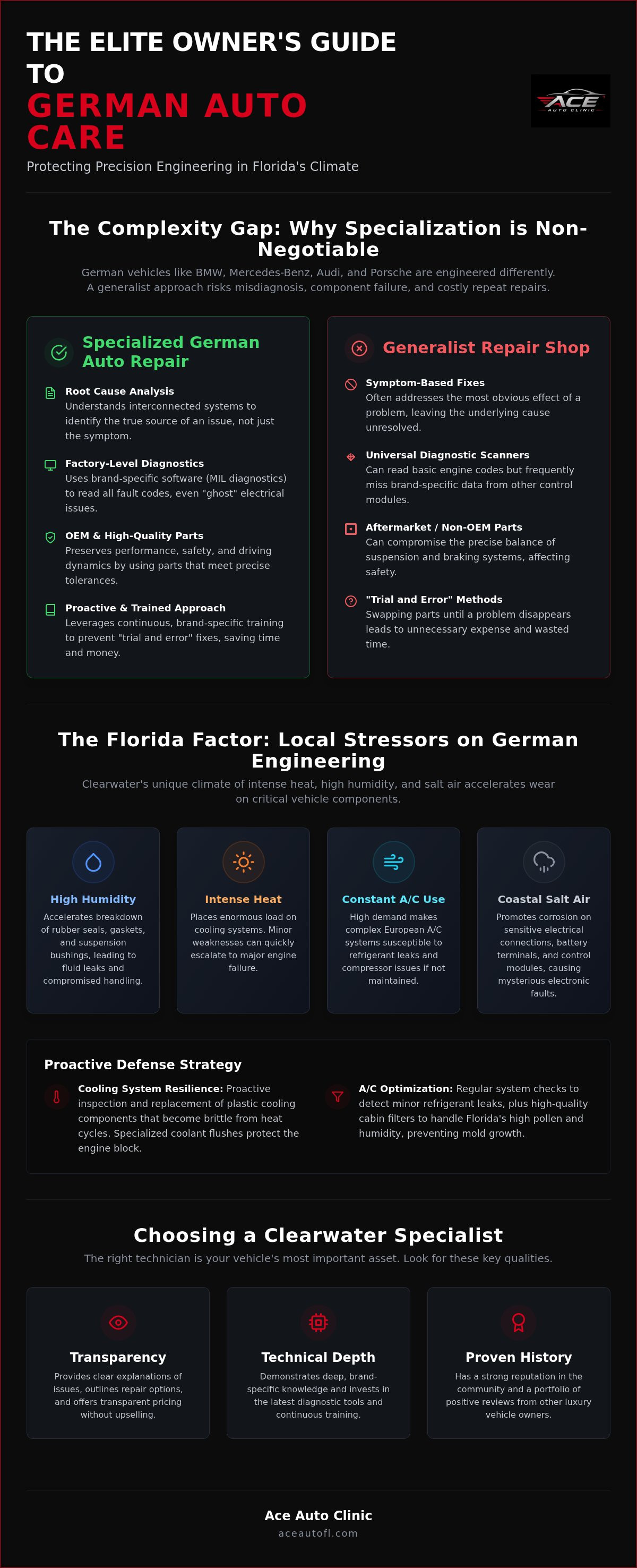
The engineering philosophy behind German automobiles like Audi, BMW, Porsche, and Mercedes-Benz creates a significant complexity gap that generalist repair shops often struggle to bridge. These vehicles are built with tighter tolerances, proprietary electronic systems, and advanced materials that demand specialized knowledge, tools, and parts. Attempting to service them with universal equipment or a one-size-fits-all approach can lead to misdiagnosis, premature component failure, and costly repeat visits.
- Specialized vs. Generic Repair: A general mechanic may address a symptom, but a specialist in German auto repair understands the interconnected systems behind it. This knowledge is crucial for identifying the root cause of an issue, not just its most obvious effect.
- Diagnostic Limitations: Universal diagnostic scanners can read basic engine codes but frequently miss brand-specific fault codes stored in the numerous control modules of a modern BMW or Audi. This can leave underlying electrical or mechanical issues unresolved.
- The Risk of Aftermarket Parts: Using non-OEM (Original Equipment Manufacturer) parts can compromise the precise balance of high-performance suspension and braking systems, affecting both safety and driving dynamics.
- A Proactive Approach: Specialists receive continuous, brand-specific training. This expertise prevents the "trial and error" method of swapping parts until a problem disappears, saving you time and money.
Proprietary Technology and the MIL Diagnostic Process
What many drivers call a "check engine light" is more accurately known as a Malfunction Indicator Light (MIL) in German vehicles. This distinction is important because the MIL is the gateway to a complex network of vehicle-specific data. A specialist uses factory-level diagnostic software that communicates with every control unit in the car, from the engine and transmission to the climate control and infotainment systems. This comprehensive scan is the only way to uncover "ghost" electrical issues or intermittent faults that generic tools cannot detect, especially in complex brands like Mercedes-Benz and Porsche. Simply clearing a code without a full system scan is a recipe for recurring problems.
The Specialist Advantage for Luxury Performance
Maintaining the performance you expect from a German vehicle requires meticulous attention to its unique engineering. European engines are designed with closer tolerances that demand specific fluid viscosities and formulations to prevent premature wear. For example, the advanced cooling systems in modern BMWs are highly effective but rely on specific procedures and coolants to function correctly. A specialist understands the nuances of systems like Audi's Quattro all-wheel drive or Porsche's dynamic chassis control, ensuring that every component works in harmony as the manufacturer intended.
[Schedule Your Precision Diagnostic Appointment at Ace Auto Clinic](https://www.aceautofl.com/contact)
The Florida Factor: Protecting German Engineering from Clearwater Heat
German vehicles are engineered to excel on the Autobahn, but they live and operate in the challenging environment of Clearwater. The combination of intense heat, high humidity, and coastal salt air creates a unique set of stressors that can accelerate wear and tear on even the most well-built machines. A proactive maintenance strategy focused on these local factors is key to long-term reliability.
- Humidity and Material Degradation: Clearwater’s persistent humidity can speed up the breakdown of rubber seals, gaskets, and suspension bushings, leading to fluid leaks and compromised handling.
- Cooling System Stress: The relentless summer heat places an enormous load on your vehicle's cooling system. A minor weakness can quickly escalate into a catastrophic engine failure in stop-and-go traffic.
- A/C System Demands: European A/C systems are complex and often use specific refrigerants. The constant demand in Florida makes them susceptible to leaks and compressor issues if not meticulously maintained.
- Electrical Corrosion: The salt-laden coastal air can promote corrosion on sensitive electrical connections, battery terminals, and control modules, causing mysterious and hard-to-diagnose electronic problems.
A/C and Climate Control Optimization
In Florida, your vehicle's air conditioning is more than a comfort feature; it is essential. A properly functioning A/C system also plays a role in cooling secondary electronic modules in some luxury models. To keep your system running efficiently, specialists recommend using high-quality cabin filters designed for high pollen and humidity, which also helps prevent the growth of mold and musty odors in the vents. Regular system checks can detect minor refrigerant leaks before they damage expensive components like the compressor.
Cooling System and Engine Resilience
The plastic components used in many German cooling systems can become brittle over time when exposed to Florida's extreme temperature cycles. A specialist knows to inspect these parts proactively and recommend replacement before they fail. Furthermore, services like professional oil and fluid testing can provide a detailed analysis of your engine's internal health, revealing early signs of wear or contamination caused by high heat. A specialized coolant flush for a high-performance German radiator is also different from a generic service, ensuring the correct coolant type and concentration are used to protect the engine block and components.
Evaluating a Clearwater Specialist: What Luxury Owners Must Know
Choosing the right technician is the most important decision you can make for the health of your vehicle. Not all shops that service European cars have the same level of equipment or expertise. A true specialist provides transparency, demonstrates deep technical knowledge, and has a proven history of reliability in the community.
- Verify Diagnostic Hardware: Ask if the shop uses brand-specific diagnostic hardware and software, not just a generic OBD-II scanner.
- Inquire About Experience: A qualified technician should be able to discuss their experience with specific generations of Audi, BMW, or Mercedes-Benz vehicles.
- Assess Inspection Transparency: If you are buying a used luxury car, a thorough pre-purchase inspection from a specialist should include a detailed report and clear explanations of any findings.
- Look for a Local Legacy: A shop that has served the Clearwater area for decades is a strong indicator of community trust and consistent quality.
Technical Questions for Your Service Advisor
When you contact a shop, being prepared with specific questions can help you gauge their expertise. Consider asking the following:
- "Do you use OEM or high-quality European-spec parts for my specific model?"
- "Can you provide a detailed report from the MIL diagnostic scan, not just the error codes?"
- "What is your process for diagnosing complex electrical issues in modern German vehicles?"
The Ace Auto Clinic Legacy in Clearwater
In a rapidly changing automotive landscape, stability and experience matter. Ace Auto Clinic was founded in 1989, and for over three decades, we have been dedicated to providing precision German auto repair for the Clearwater community. Our boutique service model offers a true dealer alternative, delivering meticulous, specialized care without the corporate markups. We have built our reputation on a commitment to diagnostic accuracy and protecting our clients' luxury investments for the long term. Trust the team that has grown and evolved alongside the very technology we service.
Frequently Asked Questions About German Auto Repair
Why is German auto repair more specialized than domestic car service?
German vehicles are engineered with a focus on performance and advanced technology. This results in more complex electronic systems, tighter mechanical tolerances, and proprietary components that require brand-specific diagnostic tools, specialized training, and precise procedures that differ significantly from most domestic vehicles.
How does the Clearwater climate affect my BMW or Mercedes-Benz cooling system?
The intense heat and humidity in Clearwater place a constant, heavy load on your cooling system. This accelerates the aging of plastic components, rubber hoses, and water pumps. High ambient temperatures reduce the system's efficiency, making it critical to maintain proper coolant levels and ensure the entire system is free of leaks or weaknesses.
Can a specialist shop perform the same diagnostics as a Clearwater dealership?
Yes, a well-equipped independent specialist can. Top-tier independent shops invest in the same factory-level diagnostic software and hardware used by dealerships. This allows them to perform comprehensive system scans, program new modules, and access deep-level data that generic scanners cannot.
Is oil testing really necessary for high-performance German engines?
While not required for every oil change, periodic oil testing is a powerful preventative maintenance tool. It provides a scientific analysis of what is happening inside your engine by detecting microscopic metal particles, fuel dilution, or coolant contamination long before they cause a major failure, which is especially valuable for high-performance or aging engines.
How often should I have the A/C system checked on my Porsche or Audi in Florida?
Given the near-constant use in Florida, it is wise to have your A/C system professionally inspected at least once a year, typically before the summer heat arrives. This allows a technician to check refrigerant levels, inspect for leaks, and ensure the compressor and other components are operating correctly, preventing a sudden failure on the hottest day of the year.
Disclaimer
Disclaimer: This article is provided by ACE Auto Clinic for general educational and informational purposes only. It is not intended to diagnose a vehicle, recommend a specific repair, replace a professional inspection, or serve as a substitute for the manufacturer’s service information.
Vehicle designs, specifications, maintenance requirements, symptoms, and repair procedures vary by year, make, model, equipment, modifications, operating conditions, and vehicle history. Information may also change as manufacturers release updated procedures and technical guidance. Do not make maintenance, repair, safety, or purchasing decisions based solely on this article.
Some content may be prepared using artificial-intelligence-assisted tools and may contain errors, omissions, or outdated information. ACE Auto Clinic makes reasonable efforts to provide useful information but does not guarantee that all content is complete, accurate, current, or applicable to every vehicle.
Always consult your vehicle’s owner’s manual and have the vehicle inspected by a qualified automotive professional before authorizing repairs or attempting service. ACE Auto Clinic is not responsible for damages, losses, injuries, repair costs, or other consequences resulting from reliance on or misuse of this information, to the fullest extent permitted by law.
References to vehicle manufacturers, product names, trademarks, and service procedures are for identification and educational purposes only and do not imply sponsorship, endorsement, or affiliation unless expressly stated.