A single morning spent looking at a sagging corner on your luxury sedan can transform a routine commute into a source of significant financial anxiety. You likely chose your vehicle for its unparalleled ride quality, yet the complexity of the airmatic mercedes benz system often brings concerns regarding maintenance and potential repair costs. It's a sophisticated network of air springs and sensors that requires specialized knowledge to maintain properly.
This article clarifies the internal mechanics of your suspension and outlines the specific warning signs of component fatigue. You'll discover how to identify issues with air springs, which typically show wear between 50,000 and 70,000 miles, and learn why proactive care is the most effective way to avoid being stranded. We'll also discuss how dealer trained technicians provide the precision diagnostics necessary to keep your Mercedes-Benz performing at its peak without the traditional dealership price tag.
Key Takeaways
- Understand how the airmatic mercedes benz system utilizes pressurized air struts and adaptive damping to provide superior ride quality compared to traditional steel springs.
- Learn to recognize early physical warning signs of suspension failure, such as a vehicle that sits unevenly or appears to squat after being parked.
- Identify why audible indicators, like a frequently running or noisy compressor motor, require immediate attention to prevent more extensive damage to the system.
- Recognize the necessity of specialized diagnostic software and dealer trained technicians for performing precise system calibrations and leak testing.
What is Mercedes-Benz Airmatic Suspension and How Does It Function?
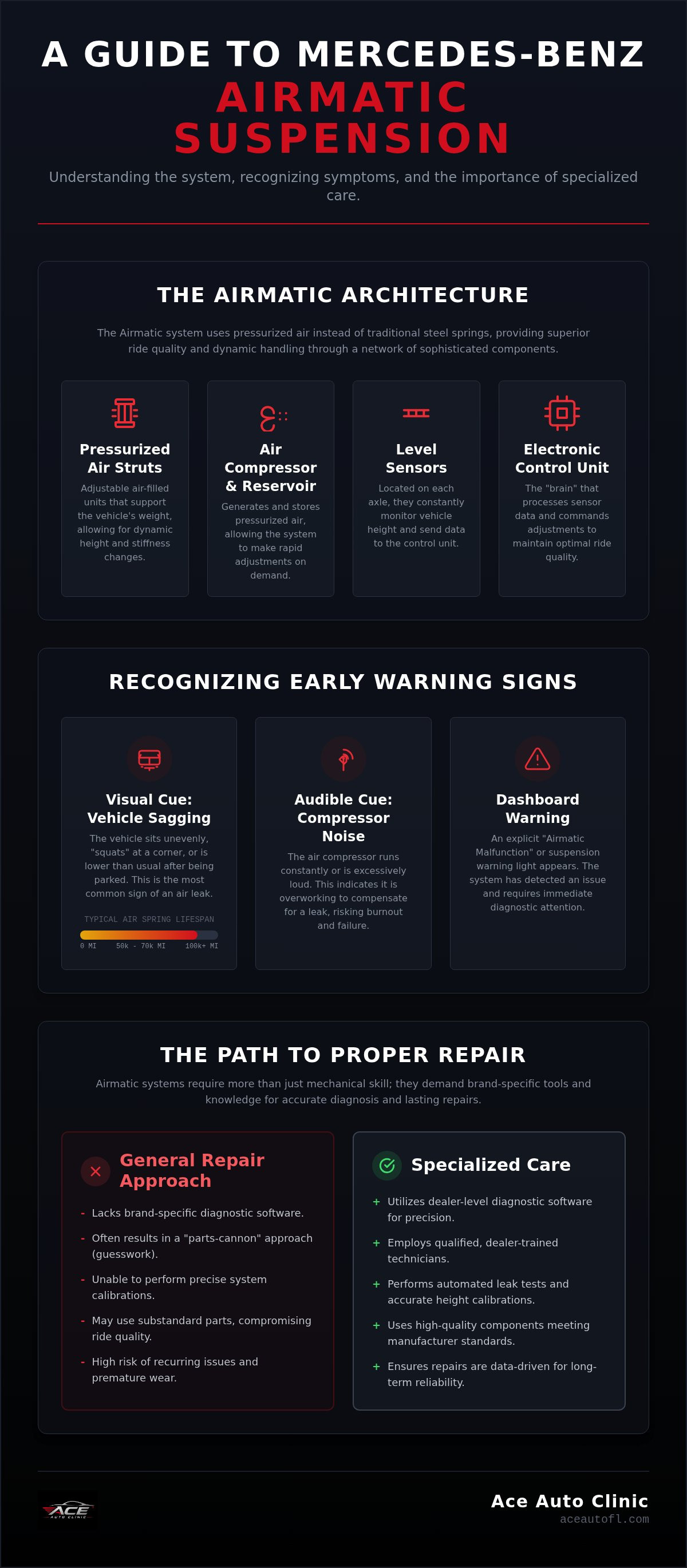
The airmatic mercedes benz system represents a significant evolution in automotive chassis engineering. Unlike conventional suspension setups that rely on static steel springs, this electronically controlled system utilizes pressurized air struts. These struts allow the vehicle to support varying loads while maintaining a consistent chassis height. This provides a level of refinement that traditional mechanical systems simply can't replicate.
Central to this performance is the Adaptive Damping System (ADS PLUS). It works in tandem with the air springs to adjust individual wheel damping in milliseconds. It reacts instantly to road surface changes and driver input. While systems like Mercedes-Benz Active Body Control focus on hydraulic active suspension, Airmatic delivers a balanced combination of pneumatic comfort and dynamic handling.
Stability is further enhanced by the speed-dependent lowering feature. At highway speeds, the system automatically reduces the vehicle's ride height. This lower center of gravity improves aerodynamic efficiency and vehicle stability. It ensures a planted feel during high-speed transit.
Key Components of the Airmatic Architecture
The system relies on an electric compressor and a central reservoir to manage system pressure effectively. The compressor generates the necessary pneumatic force. The reservoir stores pressurized air to allow for rapid height adjustments without overtaxing the motor. Level sensors located on each axle continuously communicate with the electronic control unit. This constant feedback loop ensures the vehicle remains perfectly level regardless of passenger weight or cargo distribution. When seeking Mercedes-Benz service, it's essential to utilize dealer trained technicians who understand these intricate pneumatic relationships.
Identifying Common Airmatic Symptoms and Maintenance Requirements
The most immediate sign of failure in an airmatic mercedes benz system is a change in the vehicle's stance. You may notice your sedan sitting lower on one side or "squatting" toward the rear after being parked overnight. These are clear indicators of a pneumatic leak. Beyond visual cues, pay attention to audible warnings. An air compressor motor that runs constantly or sounds excessively loud is working overtime to compensate for a loss of pressure. If left unaddressed, the compressor will eventually fail due to overheating.
When the dashboard displays a suspension warning for your airmatic mercedes benz, it's a signal that the control module has detected a deviation from standard operating parameters. Prompt diagnostics are critical at this stage. Delaying a professional assessment often leads to a chain reaction of component failures, turning a simple seal replacement into a full system overhaul. For a deeper technical breakdown of these failure points, consult this Definitive Guide to Airmatic Suspension.
The Impact of Florida Climate on Suspension Longevity
Clearwater's intense heat and high humidity create a challenging environment for European luxury vehicles. These conditions accelerate the dry-rotting of rubber air bellows and seals, which are the most vulnerable parts of the system. Proactive suspension inspections as part of a comprehensive maintenance package can identify these micro-cracks before they lead to a total collapse. If you've noticed your vehicle riding differently, you can schedule a specialized evaluation with our qualified team to ensure your system remains pressurized and safe.
Professional Diagnostics and Repair for Mercedes-Benz Systems
Precision is paramount when addressing an airmatic mercedes benz failure. Unlike standard suspension systems, these pneumatic components require deep integration with the vehicle's central computer. Specialized diagnostic software is necessary to initiate automated leak tests and perform the precise height calibrations required after any component replacement. Without these tools, a vehicle may sit unevenly or suffer from incorrect sensor readings, leading to premature wear on new parts.
The complexity of these systems underscores the value of Mercedes-Benz service performed by qualified, dealer trained technicians. These professionals understand the specific torque sequences and pneumatic sealing requirements unique to European luxury engineering. Utilizing high-quality components is equally vital. Substandard parts often fail to meet the rigorous damping standards set by the manufacturer, which compromises the refined ride quality you expect from your vehicle.
Why Specialized Care Outperforms General Repair Shops
Generalist mechanics often lack the brand-specific equipment necessary to communicate with the airmatic mercedes benz control module. This frequently results in a "parts-cannon" approach where components are replaced based on guesswork rather than data-driven diagnostics. In Clearwater, seeking a trusted automotive partner ensures your repairs are backed by professional craftsmanship and transparent technical insights. Our methodical approach eliminates the uncertainty often associated with complex suspension work, providing a high-integrity alternative to the dealership experience.
Preserving Your Mercedes-Benz Ride Quality
Maintaining the sophisticated airmatic mercedes benz system is essential for preserving the luxury driving experience you expect. By recognizing early visual cues like uneven vehicle height and addressing audible compressor warnings promptly, you can prevent minor leaks from becoming expensive mechanical failures. It's important to utilize the right tools for these complex repairs to ensure long-term reliability.
At Ace Auto Clinic, our family-owned facility has served the Clearwater community since 1989, offering a high-integrity alternative to the dealership. We utilize specialized European diagnostic equipment to perform the precise calibrations your suspension requires. Our dealer trained technicians focus on technical accuracy to ensure every component functions according to factory specifications. Protecting your investment starts with proactive care and specialized knowledge. We remain a reliable source for your maintenance needs, ensuring your vehicle continues to perform at its peak.
Frequently Asked Questions
Is it safe to drive my Mercedes-Benz if the Airmatic warning light is on?
Driving with an active suspension warning light is not recommended and can be hazardous. If the system fails completely while you are in motion, the vehicle may drop to its bump stops; this severely limits steering and braking control. Continued operation also forces the compressor to run indefinitely to compensate for leaks, which eventually causes the motor to burn out.
How long do Mercedes-Benz air suspension struts typically last in Florida?
In the humid Florida climate, the typical lifespan of airmatic mercedes benz springs is between 50,000 and 70,000 miles. High temperatures and salt air accelerate the degradation of the rubber bellows, leading to micro-cracks and eventual pressure loss. Regular inspections by qualified technicians can identify these early signs of rubber fatigue before a total failure occurs.
Can I replace just one air strut or should they be replaced in pairs?
Replacing air struts in pairs is the standard recommendation to ensure balanced handling and ride height. Both struts on an axle are typically subject to the same environmental wear and mileage, so the second unit often fails shortly after the first. Installing a new strut alongside an aged one can also create an uneven damping response.
What is the difference between Airmatic and ABC (Active Body Control) suspension?
The primary difference lies in the medium used to support the vehicle. The airmatic mercedes benz system uses pressurized air and pneumatic struts to manage ride quality and height. In contrast, Active Body Control is a high-pressure hydraulic system. It uses fluid and high-speed servos to actively counteract body roll and pitch during cornering or braking.
Disclaimer
Disclaimer: This article is provided by ACE Auto Clinic for general educational and informational purposes only. It is not intended to diagnose a vehicle, recommend a specific repair, replace a professional inspection, or serve as a substitute for the manufacturer’s service information.
Vehicle designs, specifications, maintenance requirements, symptoms, and repair procedures vary by year, make, model, equipment, modifications, operating conditions, and vehicle history. Information may also change as manufacturers release updated procedures and technical guidance. Do not make maintenance, repair, safety, or purchasing decisions based solely on this article.
Some content may be prepared using artificial-intelligence-assisted tools and may contain errors, omissions, or outdated information. ACE Auto Clinic makes reasonable efforts to provide useful information but does not guarantee that all content is complete, accurate, current, or applicable to every vehicle.
Always consult your vehicle’s owner’s manual and have the vehicle inspected by a qualified automotive professional before authorizing repairs or attempting service. ACE Auto Clinic is not responsible for damages, losses, injuries, repair costs, or other consequences resulting from reliance on or misuse of this information, to the fullest extent permitted by law.
References to vehicle manufacturers, product names, trademarks, and service procedures are for identification and educational purposes only and do not imply sponsorship, endorsement, or affiliation unless expressly stated.