Owning an Audi Diesel vehicle represents a commitment to a sophisticated engineering philosophy that prioritizes torque and efficiency. You likely chose your TDI for its remarkable fuel economy and long distance capabilities, yet the technical requirements of these engines can often lead to maintenance anxiety. This guide will clarify the mechanical nuances of your vehicle, showing you how to maintain the efficiency and longevity of your Audi Diesel engine through specialized insights and proactive care. We will examine the critical role of specific oil standards, the function of the Diesel Particulate Filter, and the importance of precise AdBlue service intervals to ensure your vehicle remains reliable. By following a structured maintenance schedule, you can enjoy the confidence of owning a high mileage European vehicle that performs with the same precision it did on the day it was manufactured.
Key Takeaways
- Understand how Turbocharged Direct Injection (TDI) systems utilize high pressure fuel delivery and variable geometry turbochargers to maximize engine efficiency.
- Learn why adhering to manufacturer specific oil standards and AdBlue service intervals is essential for the longevity of your Audi Diesel engine.
- Discover the role of advanced diagnostic equipment in monitoring Diesel Particulate Filter health and preventing costly soot accumulation.
- Identify early indicators of common mechanical issues such as glow plug wear and turbocharger carbon buildup to maintain peak vehicle performance.
Understanding Audi Diesel Technology: The TDI Legacy
Audi's reputation for engineering excellence is clearly visible in its diesel lineup. The development of Audi's TDI engine technology revolutionized the European automotive market by combining the fuel economy of a diesel with the performance expectations of a luxury brand. These engines utilize Turbocharged Direct Injection to deliver significant low-end torque and superior thermal efficiency. Specialized technicians recognize these Audi Diesel powerplants for their exceptional durability. While the available information on these systems is vast, understanding the complex interplay of mechanical and electronic components requires specific, dealer trained insights.
Defining the Mechanics of Audi TDI Systems
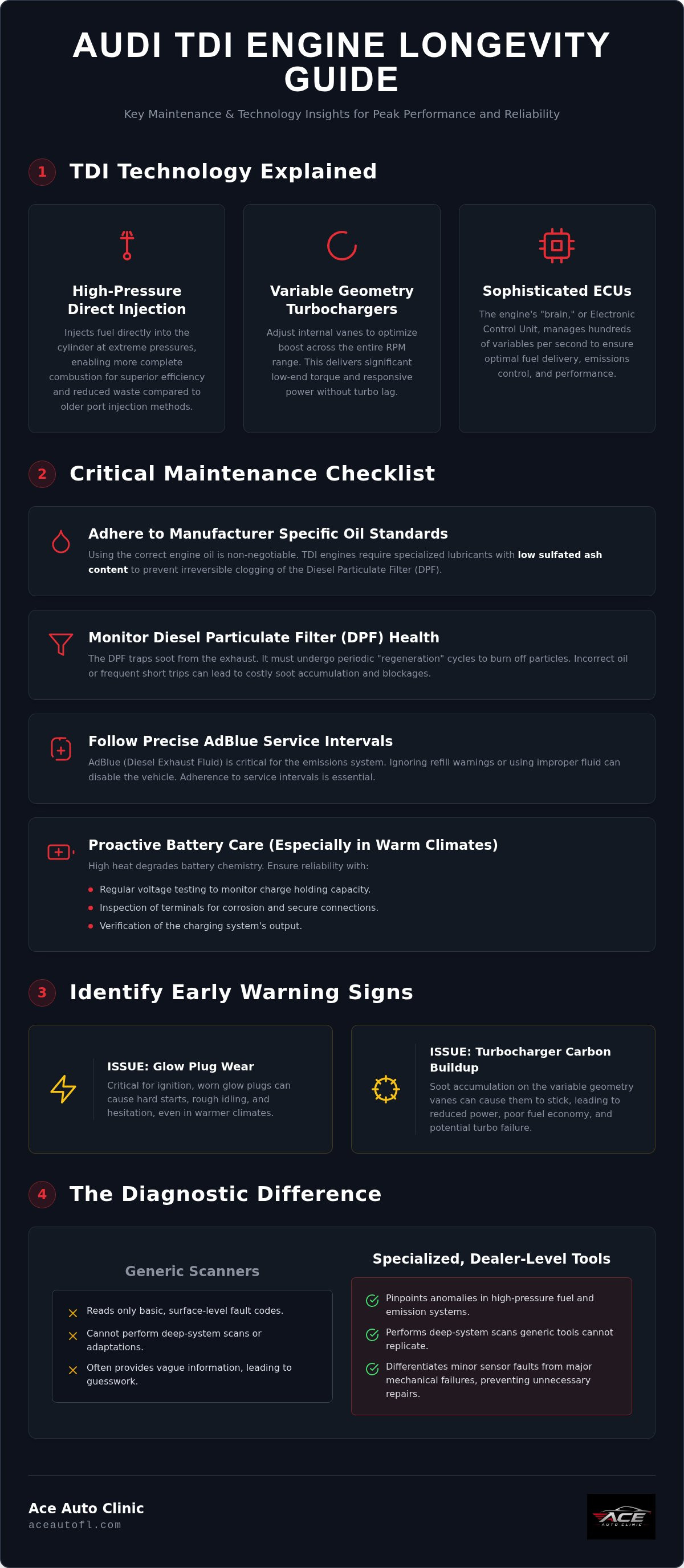
The core of the Audi Diesel system is the transition from older port injection methods to a sophisticated high pressure direct injection design. In traditional port injection, fuel is mixed with air before entering the combustion chamber. TDI systems inject fuel directly into the cylinder at extremely high pressures, which facilitates more complete combustion and reduced waste. This level of technical precision is a hallmark of the European luxury diesel hierarchy, which includes leading systems from Audi, BMW, and Mercedes-Benz. To achieve peak performance, the system relies on several critical components:
- High pressure common rail fuel delivery for precise timing.
- Variable geometry turbochargers that optimize boost across the RPM range.
- Sophisticated electronic control units that manage hundreds of variables per second.
TDI serves as the definitive engineering standard for modern high-performance diesel engines. Qualified technicians must understand these intricate nuances to ensure the vehicle operates at its designed efficiency levels and maintains its structural integrity over hundreds of thousands of miles. This specialized knowledge is what separates routine maintenance from high-level Audi Service & Repair.
Essential Maintenance for Your Audi Diesel Engine
Adhering to the manufacturer's specific maintenance schedule is the most effective way to protect the longevity of your Audi Diesel engine. Diesel combustion naturally produces more soot than gasoline alternatives. This particulate matter can contaminate lubricants and lead to internal wear if left unaddressed. Consequently, regular oil and fluid testing services are essential for identifying microscopic contaminants before they cause mechanical failure. Qualified technicians understand that specialized diagnostics and repair protocols are required to monitor these fluid properties accurately.
The environmental conditions in Clearwater create specific challenges for European diesel vehicles. Florida's high ambient temperatures place significant stress on the cooling system and the vehicle's battery. Audi Diesel engines require high cranking amps to overcome the high compression ratios during startup. Because heat accelerates the degradation of battery chemistry, several maintenance steps are vital:
- Regular voltage testing to ensure the battery maintains its charge.
- Inspection of terminal connections to prevent resistance and corrosion.
- Verification of the charging system's output to ensure the battery remains fully charged.
Monitoring these components helps avoid the inconvenience of unexpected breakdowns in the Florida heat.
Engine Oil Standards and Diesel Particulate Filter Care
Maintaining the Diesel Particulate Filter (DPF) is one of the most critical aspects of modern diesel ownership. The DPF captures soot from the exhaust stream and must undergo periodic regeneration cycles to burn off these particles. Using engine oil that doesn't meet exact Audi standards can lead to irreversible DPF clogging. These specialized lubricants are formulated with lower sulfated ash content to prevent ash buildup within the filter's ceramic structure. If you have questions about your specific maintenance requirements, you can speak with a specialized technician to establish a proactive care plan.
Specialized Diagnostics and Repair for TDI Owners in Clearwater
Qualified technicians utilize advanced diagnostic software to pinpoint anomalies within the high-pressure fuel systems and emission controls of an Audi Diesel. Common mechanical concerns often include glow plug wear, which remains critical for ignition timing even in Florida’s climate, and carbon buildup within the variable geometry turbochargers. Identifying these issues early prevents catastrophic engine failure and preserves the vehicle's performance. This specialized approach to maintenance is equally applicable to other precision-engineered European brands such as BMW and Mercedes-Benz, where electronic integration is similarly complex.
When the Malfunction Indicator Light (MIL) illuminates, it signifies a deviation from the vehicle's tight operational parameters. Diagnostic precision is required to differentiate between a minor sensor fault and a significant mechanical failure. Because modern diesel systems are highly integrated, a fault in the exhaust gas recirculation system can quickly affect fuel efficiency and power delivery. Dealer trained technicians use manufacturer-level tools to perform deep-system scans that generic scanners cannot replicate.
Addressing Audi Diesel Warning Lights and Performance Issues
Specialized diagnostic equipment is indispensable for identifying subtle fuel system leaks that might otherwise go unnoticed until they cause significant damage. For those considering the acquisition of a used TDI model, a pre-purchase inspection is vital to verify the integrity of the high-pressure fuel pump and the emission control components. Local owners in Clearwater and Largo should prioritize specialized Audi service and repair to ensure their vehicles withstand the unique humidity and heat of the Gulf Coast. This disciplined strategy ensures that your high-performance diesel remains a reliable asset throughout its service life.
Securing the Future of Your High-Performance TDI
Maintaining an Audi Diesel requires a disciplined approach to technical care and a commitment to manufacturer standards. By prioritizing precise oil specifications and monitoring exhaust emission systems, you ensure your vehicle continues to deliver the torque and efficiency that define the European driving experience. Ace Auto Clinic has served the Clearwater community since 1989, providing a reliable alternative to the dealership for sophisticated mechanical care. Our qualified technicians utilize specialized diagnostic equipment to manage the intricate needs of luxury diesel engines with accuracy. Trusting your vehicle to those with dealer level training protects your investment and ensures long term mechanical reliability.
Establishing a consistent maintenance routine today will preserve the sophisticated engineering of your vehicle for many miles of efficient travel.
Frequently Asked Questions
How often should I change the oil in my Audi Diesel engine?
Audi typically recommends an oil service every 10,000 miles or once per year. However, the stop and go traffic in Clearwater and high humidity can degrade oil faster. We often suggest intervals between 5,000 and 7,500 miles. This ensures optimal protection. Using specialized lubricants that meet exact manufacturer standards is essential to prevent soot buildup and protect your vital engine components.
What happens if my Audi TDI runs out of AdBlue fluid?
If your AdBlue tank empties completely, your Audi Diesel engine won't restart after you turn off the ignition. The vehicle provides multiple warnings starting around 1,500 miles before the fluid is depleted. It's critical to top off the fluid during regular maintenance. This avoids being stranded. Qualified technicians can ensure the sensors are functioning correctly.
Why is my Audi Diesel Malfunction Indicator Light on?
The Malfunction Indicator Light (MIL) illuminates when the onboard computer detects a fault in the engine management or emission systems. Common triggers include a clogged Diesel Particulate Filter or faulty glow plugs. Specialized diagnostics are required to identify the fault. This prevents unnecessary parts replacement. Accurate scanning ensures your vehicle meets its designed performance standards.
Is the Florida heat harder on Audi Diesel engines than gasoline engines?
The intense Florida heat is particularly challenging for an Audi Diesel because it operates at higher internal pressures. High ambient heat places extra strain on the cooling system. This accelerates battery degradation. Since these engines require significant cranking power to start, a heat weakened battery often fails prematurely. Owners in Clearwater and Largo should prioritize cooling system inspections.
Disclaimer
Disclaimer: This article is provided by ACE Auto Clinic for general educational and informational purposes only. It is not intended to diagnose a vehicle, recommend a specific repair, replace a professional inspection, or serve as a substitute for the manufacturer’s service information.
Vehicle designs, specifications, maintenance requirements, symptoms, and repair procedures vary by year, make, model, equipment, modifications, operating conditions, and vehicle history. Information may also change as manufacturers release updated procedures and technical guidance. Do not make maintenance, repair, safety, or purchasing decisions based solely on this article.
Some content may be prepared using artificial-intelligence-assisted tools and may contain errors, omissions, or outdated information. ACE Auto Clinic makes reasonable efforts to provide useful information but does not guarantee that all content is complete, accurate, current, or applicable to every vehicle.
Always consult your vehicle’s owner’s manual and have the vehicle inspected by a qualified automotive professional before authorizing repairs or attempting service. ACE Auto Clinic is not responsible for damages, losses, injuries, repair costs, or other consequences resulting from reliance on or misuse of this information, to the fullest extent permitted by law.
References to vehicle manufacturers, product names, trademarks, and service procedures are for identification and educational purposes only and do not imply sponsorship, endorsement, or affiliation unless expressly stated.