Can a Mercedes Diesel engine truly reach its legendary high-mileage potential without a specific technical maintenance strategy? Many owners in Clearwater choose these vehicles for their exceptional efficiency, yet they often feel overwhelmed by the complexities of the BlueTEC emissions system and the high costs of specialized components. It's a common frustration to search for qualified technicians who truly understand the nuances of these sophisticated powerplants.
This guide offers a clear understanding of the maintenance standards and specialized diagnostic requirements necessary to preserve the longevity of your Mercedes-Benz. You'll discover how adhering to precise technical standards, such as using MB 229.51 or 229.52 low-ash oils, ensures your engine remains efficient. We will also examine how documented care from dealer trained technicians can maximize your vehicle's resale value and provide the confidence you need to enjoy your luxury investment on the road.
Key Takeaways
- Understand the evolution of the Mercedes-Benz diesel platform and how BlueTEC technology optimizes fuel efficiency and torque.
- Identify the specific MB 229.51 and 229.52 low-ash oil standards required to protect the health of your diesel particulate filter.
- Learn how specialized diagnostic tools and qualified technicians address the unique challenges Florida heat poses to Mercedes Diesel electrical systems.
- Discover proactive maintenance strategies for fuel filters and injectors that help preserve the long-term resale value of your luxury vehicle.
The Engineering Foundations of Mercedes-Benz Diesel Engines
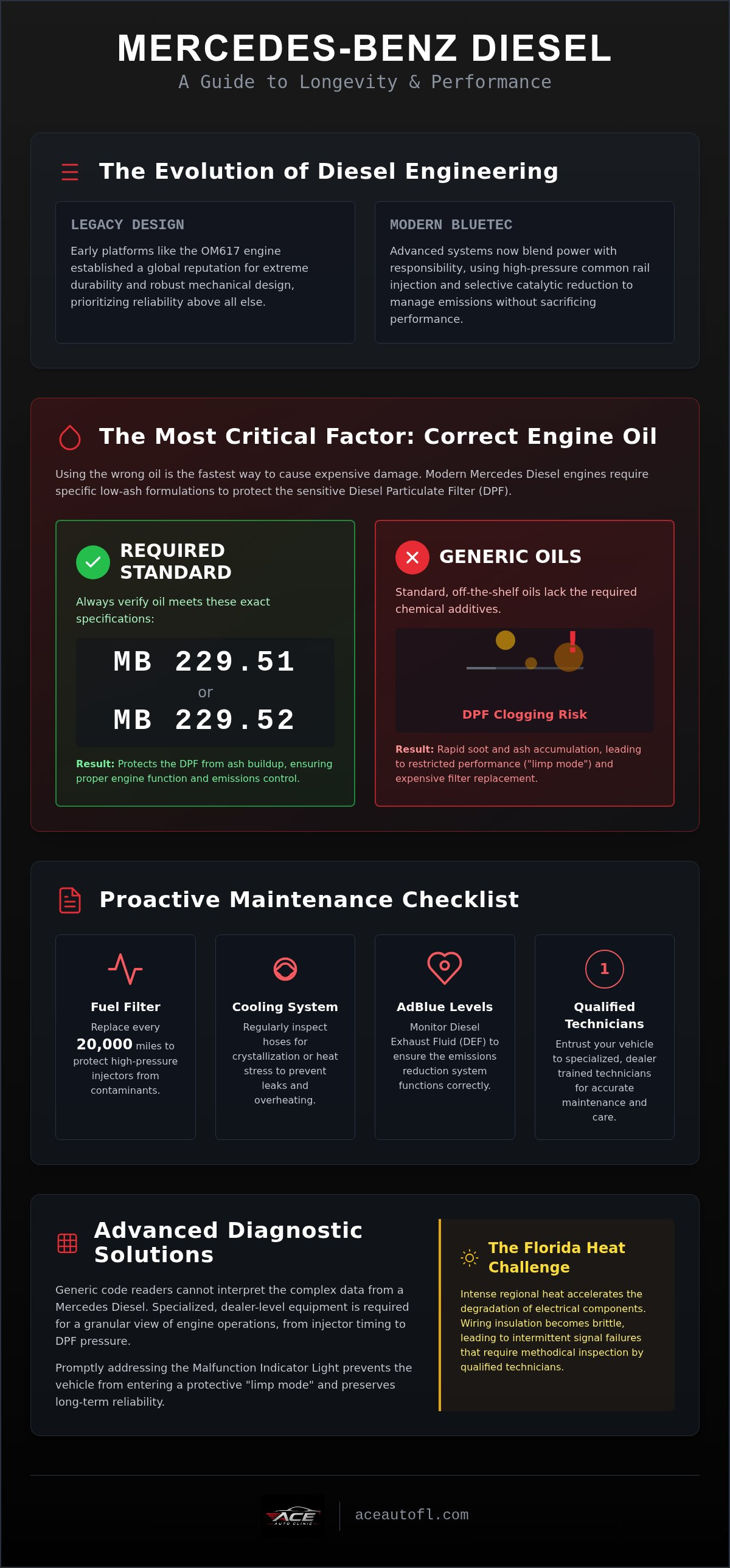
Mercedes-Benz diesel engineering is defined by a unique balance of high torque and exceptional fuel efficiency. These powerplants provide the pulling power and long-range capability that discerning luxury owners expect. The legacy of this technology began with robust mechanical designs, such as the Mercedes-Benz OM617 engine, which established the brand's global reputation for extreme durability. Today, that foundation has evolved into a highly sophisticated system that blends power with environmental responsibility.
Modern Mercedes Diesel systems have transitioned from traditional mechanical injection to the advanced BlueTEC platform. This technology utilizes selective catalytic reduction to manage emissions without compromising the engine's inherent performance characteristics. Central to this evolution is the high-pressure common rail injection system. These systems operate with a level of precision that was once impossible, delivering fuel at immense pressures to ensure complete combustion. Because these components are engineered to such tight tolerances, they demand a higher standard of maintenance to prevent premature wear and preserve the value of your luxury asset.
Common Mercedes Diesel Applications and Models
The Mercedes Diesel platform is prevalent across several key vehicle segments. In the passenger car market, the E-Class and S-Class sedans are highly regarded for their refined highway cruising capabilities, while the GLE-Class SUV offers robust towing capacity for active lifestyles. Beyond personal luxury vehicles, the Sprinter van remains a critical asset for specialized fleet operations and premium personal conversions. Maintaining these diverse models requires the specialized knowledge of dealer trained technicians who understand the nuances of each application. Utilizing Mercedes-Benz Service and Repair at a qualified facility ensures that these complex systems receive the precise care necessary to remain roadworthy in the challenging Florida climate.
Specialized Maintenance Protocols for Diesel Longevity
Maintaining a Mercedes Diesel requires a departure from standard gasoline service protocols. The most critical factor for modern longevity is the health of the Diesel Particulate Filter (DPF). Using the wrong lubricant leads to rapid ash accumulation. This eventually clogs the filter and necessitates expensive repairs. Adhering to established Heavy-Duty Diesel Engine Maintenance principles ensures you select fluids that meet the manufacturer's exacting standards.
Oil and Fluid Standards for Diesel Performance
Mercedes-Benz requires specific synthetic oil approvals, specifically MB 229.51 or 229.52. These low-ash formulations minimize the soot that standard off-the-shelf oils produce. Generic lubricants don't have the chemical additives needed for high-performance diesel internals. Utilizing professional oil and fluid testing allows specialized technicians to identify early signs of engine wear or fuel dilution. This proactive approach prevents catastrophic failures.
Precision fuel delivery is the heart of the engine. Replacing fuel filters at recommended intervals is essential to protect high-pressure injectors from microscopic contaminants. The cooling system must also remain sealed and pressurized. Diesel engines operate at high thermal loads. Any drop in cooling efficiency can lead to warped cylinder heads or gasket leaks. Following a structured maintenance checklist is the best way to preserve your vehicle's value:
- Verify oil meets MB 229.51 or 229.52 low-ash specifications.
- Replace fuel filters every 20,000 miles to protect injectors.
- Monitor AdBlue levels to ensure emissions system functionality.
- Inspect cooling hoses for crystallization or signs of heat stress.
If you have questions about your specific service interval, you can consult with our specialized team to develop a tailored maintenance plan for your vehicle.
Professional Diagnostic Solutions for Mercedes Diesel Systems
Modern Mercedes Diesel diagnostics require significantly more than a generic code reader. Because Diesel engine principles rely on high-pressure combustion and a dense network of intricate sensors, specialized technicians use dealer-level equipment to interpret specific fault codes. These tools allow for a granular view of the engine's operation, from injector timing to particulate filter pressure. Prompt malfunction indicator light diagnostics are essential to prevent the vehicle from entering 'limp mode,' a restricted performance state designed to protect the engine from severe damage. Addressing these alerts early preserves the reliability of your luxury asset and prevents safety failures on the road.
The environmental conditions in Clearwater present unique challenges for Mercedes Diesel owners. Intense Florida heat accelerates the degradation of electrical components and sensors. Under-hood temperatures can reach levels that cause wiring insulation to become brittle, leading to intermittent signal failures and complex electrical faults. Specialized care involves a methodical inspection of these sensitive electronics to ensure they remain resilient against thermal stress. This proactive approach is the best way to maintain the steady performance your vehicle was engineered to provide.
Addressing Common Diesel Performance Issues in Florida
In our local climate, we frequently observe Exhaust Gas Recirculation (EGR) valve clogging and turbocharger sensor failures. These issues often stem from the combination of high humidity and stop-and-go traffic. For a holistic approach to vehicle health, owners can refer to our guide on European Auto Repair in Clearwater FL. Additionally, since Mercedes-Benz no longer offers new diesel passenger cars in the U.S., a pre-purchase inspection is vital for anyone acquiring a used model. This service identifies existing soot buildup or sensor wear, ensuring your investment is sound.
Securing the Longevity of Your Diesel Investment
Preserving the long-term performance of a Mercedes Diesel requires a commitment to technical precision and proactive maintenance. By adhering to specialized low-ash oil standards and prioritizing professional diagnostics, you protect the intricate systems that define the modern BlueTEC platform. Technical accuracy is non-negotiable. Since 1989, our fourth-generation family-owned shop has served the Clearwater community with a focus on accurate diagnostics and transparent communication. Our dealer trained technicians provide thoughtful recommendations that address the specific thermal challenges of the Florida climate. This meticulous approach ensures your engine remains efficient and maintains its maximum resale value.
We look forward to acting as the guardian of your high-value machinery and helping you enjoy the full potential of your European luxury vehicle.
Frequently Asked Questions
Are Mercedes-Benz diesel engines as reliable as the older models?
Modern Mercedes-Benz diesel engines provide exceptional longevity when maintained with specialized care. Unlike the purely mechanical models of the past, current versions rely on sophisticated electronic sensors and emissions components. While the core engine remains robust, the complexity of the BlueTEC system means that reliability is now tied to precise diagnostic monitoring and the use of manufacturer approved fluids. Adhering to these standards ensures your vehicle remains a dependable luxury asset.
How often should I change the fuel filter in my Mercedes diesel?
For most Mercedes Diesel applications, we recommend replacing the fuel filter every 20,000 miles or during every Service B interval. These engines utilize high-pressure common rail injection systems that are intolerant of even microscopic particles. A fresh filter prevents contaminants from damaging expensive injectors and maintains steady fuel flow. This proactive step is one of the most effective ways to avoid performance issues and protect your engine internals.
What does it mean when my Mercedes displays a Diesel Exhaust Fluid warning?
A Diesel Exhaust Fluid warning signifies that the AdBlue reservoir is low and requires immediate attention. This fluid is vital for the selective catalytic reduction process that manages emissions. If the level drops too low, the vehicle's onboard computer may limit the number of engine starts available. Qualified technicians can perform a precise refill and inspect the system for any sensor faults that might cause premature warnings or performance restrictions.
Can high Florida temperatures affect my diesel engine's performance?
High temperatures in Clearwater and the surrounding Tampa Bay area definitely impact diesel performance and component life. Heat accelerates the breakdown of engine oil and can cause rubber cooling hoses to become brittle over time. The increased demand on the A/C system and cooling fans puts extra load on the electrical system. Regular oil testing and cooling system pressure checks are essential for maintaining peak efficiency in our local climate.
Disclaimer
Disclaimer: This article is provided by ACE Auto Clinic for general educational and informational purposes only. It is not intended to diagnose a vehicle, recommend a specific repair, replace a professional inspection, or serve as a substitute for the manufacturer’s service information.
Vehicle designs, specifications, maintenance requirements, symptoms, and repair procedures vary by year, make, model, equipment, modifications, operating conditions, and vehicle history. Information may also change as manufacturers release updated procedures and technical guidance. Do not make maintenance, repair, safety, or purchasing decisions based solely on this article.
Some content may be prepared using artificial-intelligence-assisted tools and may contain errors, omissions, or outdated information. ACE Auto Clinic makes reasonable efforts to provide useful information but does not guarantee that all content is complete, accurate, current, or applicable to every vehicle.
Always consult your vehicle’s owner’s manual and have the vehicle inspected by a qualified automotive professional before authorizing repairs or attempting service. ACE Auto Clinic is not responsible for damages, losses, injuries, repair costs, or other consequences resulting from reliance on or misuse of this information, to the fullest extent permitted by law.
References to vehicle manufacturers, product names, trademarks, and service procedures are for identification and educational purposes only and do not imply sponsorship, endorsement, or affiliation unless expressly stated.